
fal shipped a video model this week that renders a five second clip in about three seconds. Generation is now faster than playback.
H3 Max is fal's post-trained version of the open-weights MiniMax H3 model, detailed on fal's blog on August 27 and formally launched September 1, 2026. It ranks first on Artificial Analysis and Design Arena for image to video, and runs $0.08 per second of output once launch pricing ends. Anyone with an API key can now produce video faster than a human can sit and watch it.
Attention did not get cheaper. Deezer takes in roughly 90,000 fully AI-generated tracks a day, more than half of all daily uploads, and that entire flood accounts for 1 to 3 percent of streams. Supply went vertical but listening did not move.
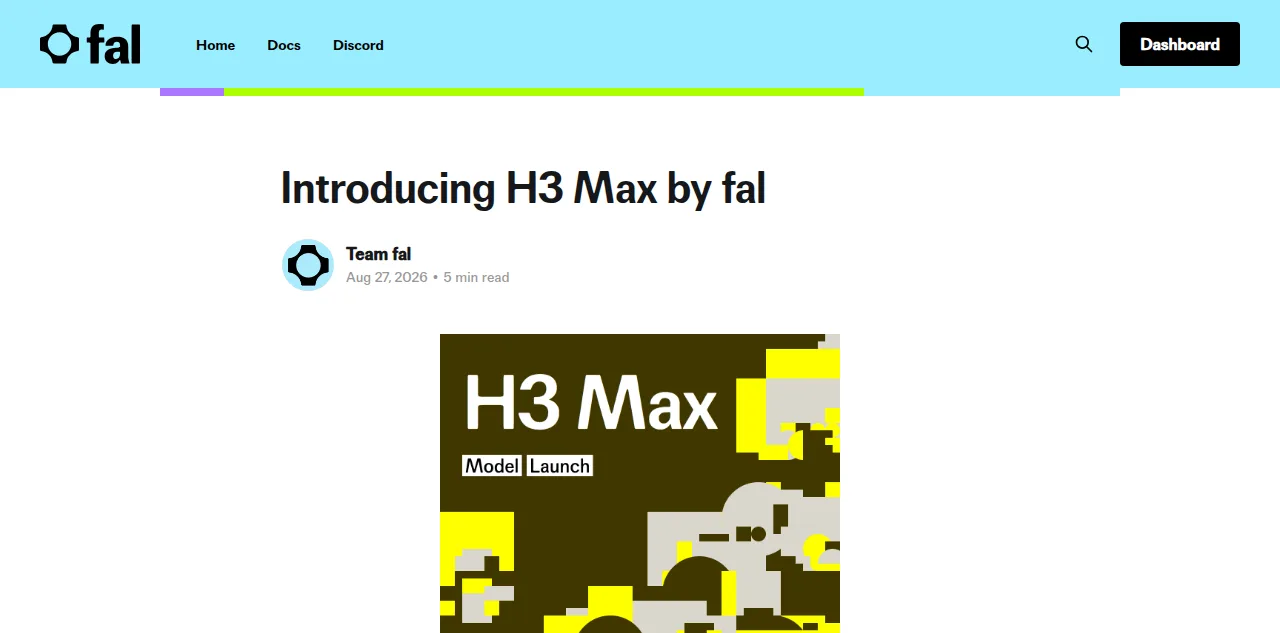
What is fal's H3 Max?
H3 Max is a post-trained version of MiniMax H3, built by fal Research and tuned by fal's inference team for speed. The announcement puts it at roughly 35 times the throughput of the official MiniMax H3 endpoint and about 15 times faster than models of comparable quality.
The quality claims hold up against outside scoring. On Design Arena's image to video board it took first with an Elo of 1,341, just above MiniMax H3 itself at 1,333. On Artificial Analysis image to video with audio it also placed first, at an Elo of 1,201 across 2,177 samples.
Pricing is the part that changes behavior. Launch week runs $0.04 per second at 768p, doubling to $0.08 after September 7. A sixty second video costs $2.40 at promotional pricing. Text to video and image to video are both live via API.
"Generative video has historically forced developers to choose between quality and speed," said Batuhan Taskaya, Head of Engineering at fal, in the launch release. "By pairing new H3 Max capabilities and fal's post training we've proven that tradeoff is unnecessary."
He is right, and that is exactly why the next few months get noisy.
What is AI slop?
AI slop is machine-generated content produced for volume rather than for a reader. A model touching it is not the problem. The tell is that nobody would notice if it vanished.
It is already a measurable share of what gets recommended. Kapwing opened a fresh YouTube account and logged the first 500 Shorts it was served: 21 percent were AI-generated and 33 percent were brainrot, using data collected through October 2025. That was before generation got fast and cheap enough to be an afterthought.
The economics used to impose a natural limit. Rendering was slow and expensive, so even low-effort creators rationed output. H3 Max removes the rationing. When a clip costs eight cents and three seconds, the marginal cost of publishing one more approaches zero, and anything with a marginal cost near zero gets produced until something else stops it.
Does cheaper AI video actually win an audience?
Music already ran this experiment, and the results are not close.
Researchers at the University of Chicago published an empirical analysis of AI slop in music streaming in June 2026. Tracking real streaming data, Wu and colleagues found that 93 percent of AI-generated tracks got fewer than 1,000 plays since release, against 64 percent of human-created tracks. Over a five month window from January to May 2026, the gap widened rather than closed.
Retention splits the same way. When an artist lands a popular track, human musicians saw a 16-fold lift in plays on what they released next. AI musicians saw 5-fold. People come back for a person. They sample a generator once and move on.
Monetization follows the same shape. Only 7.15 percent of even the most popular AI tracks cleared the play threshold to monetize at all, and among those that did, 76.5 percent earned under $10. Deezer's own accounting is blunter: up to 85 percent of streams on fully AI-generated tracks were flagged as fraudulent and demonetized in 2025. A large share of the demand for slop is not human demand at all.
Video has no reason to behave differently.
Why do recommendation algorithms bury AI slop?
Because they optimize for finishing and returning, and slop fails both.
The University of Chicago data makes the mechanism visible. AI tracks made up 5.1 percent of the catalog studied but only 1.2 percent of recommended music, roughly a quarter of their share. The recommendation graph also sorted itself: 84 percent of human-created tracks never recommended an AI track, while 93 percent of AI tracks recommended other AI tracks. Slop got quarantined into a corner of the graph that real listeners rarely enter.
Platforms are also intervening directly. Deezer says its detection tool runs at 99.8 percent accuracy and tagged 13.4 million AI-generated tracks in 2025, and it now licenses that detection to other companies.
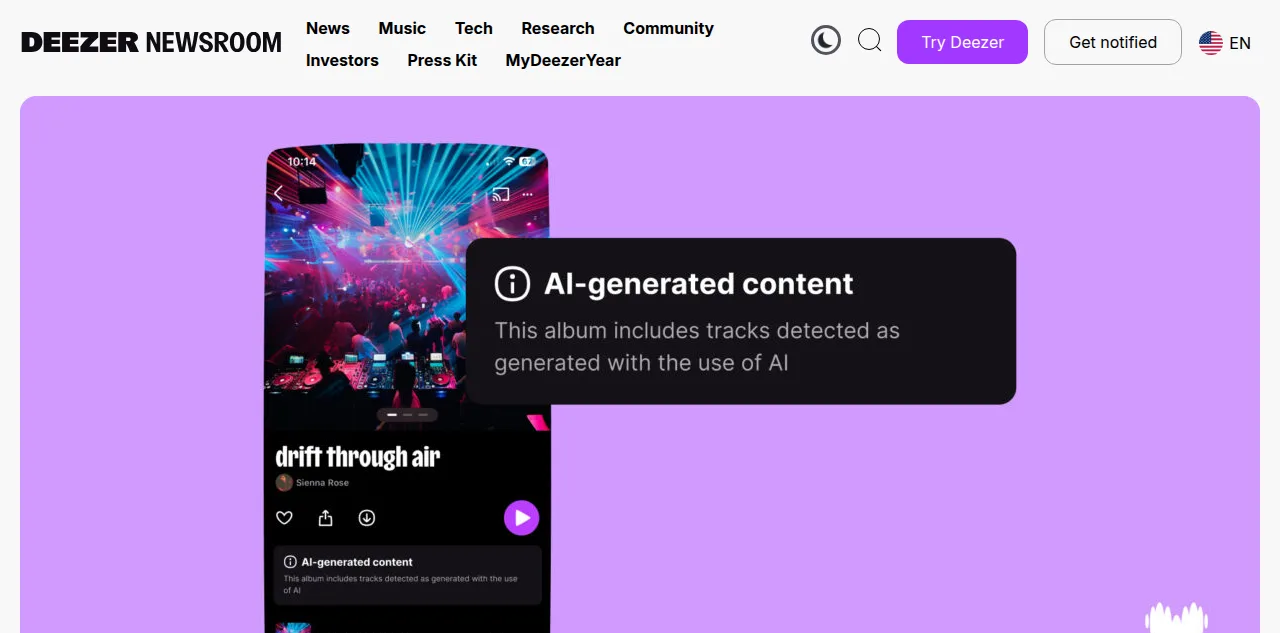
Flooding a feed does not buy distribution. It buys an AI-generated label and a demotion.
What happens to tools that generate video?
The model layer is turning into a commodity.
H3 Max is a post-trained MiniMax H3, an open-weights model, served by a company that did not train the base. fal benchmarked it against twelve others including Veo 3.1, Kling 3, and Gemini Omni Flash. Those twelve are largely interchangeable endpoints, and a marketplace like fal exists to make swapping between them a config change.
For anything that generates video as part of a larger job, that is the whole point. Jellypod already runs generative models through fal today, using Lyria 2 for the instrumental beds under narrated video, while the visual styles run on Veo 3.1 and Gemini Omni Flash. The models H3 Max was measured against are the ones already in the pipeline.
For that kind of product a faster, cheaper endpoint is a component upgrade. Cheaper seconds mean richer motion in a style like pixel art or claymation without the render cost becoming the constraint.
What does not change is where the content comes from. Jellypod generates video from an episode you built out of your own sources, not from a prompt box, and the episode is what makes the output specific. Faster models make the pixels cheaper. They do not decide what the thing is about.
That is the split worth watching as generation approaches free:
| Generation-first | Source-first | |
|---|---|---|
| Starts with | A prompt and a trend | Material you already produced |
| Scarce input | Compute | Expertise |
| Effect of a cheaper model | More output, same ceiling | Same output, lower cost |
| Defensible | No, the prompt is copyable | Yes, the source is not |
| Audience returns | Rarely (5x lift) | Often (16x lift) |
Frequently asked questions
Is H3 Max the fastest AI video model? On throughput, it is the fastest at its quality tier as of September 2026. fal reports about 35 times the throughput of the official MiniMax H3 endpoint and roughly 15 times faster than models of comparable quality, rendering a five second 768p clip in about three seconds.
How much does H3 Max cost? $0.04 per second of 768p output during launch week, rising to $0.08 per second after September 7, 2026. A five second clip is $0.20 at promotional pricing and a sixty second video is $2.40.
Is AI-generated content penalized by platforms? Not for being AI-generated as such. It is penalized for low engagement and for fraud. Deezer demonetized up to 85 percent of streams on fully AI tracks as fraudulent, and the University of Chicago study found AI tracks recommended at about a quarter of their catalog share. Poor retention is what triggers suppression.
Does using AI make my content slop? No. Slop is defined by the absence of a source and a reason, not by the tools involved. Content built from your own expertise stays yours regardless of what handled the production. The 16-fold versus 5-fold retention gap tracks whether an audience is coming back for a person.
The short version
H3 Max made video generation faster than real time and cheap enough to be thoughtless, which guarantees the feeds fill with it. Music already showed where that lands: more than half of Deezer's daily uploads are AI-generated and they draw 1 to 3 percent of streams.
Rendering was never the scarce input. Your source material is.