Close your eyes during a good audio drama and you can see the room. A door creaks, a voice you have never met says six words, and you know who they are.
An audio drama, also called a radio drama, is a story performed entirely in sound: a cast voices the characters, and dialogue, music, and sound effects do the work that sets and cameras do on screen. It is written for the ear from the start, which separates it from an audiobook, where a narrator reads a book written for the page. "Fiction podcast" usually means an audio drama released through a podcast feed.
You no longer need a studio to make one. With Jellypod's AI audio drama maker, you import or write a script, give each character a saved voice, and publish episodes to Spotify and Apple Podcasts.
Key takeaways
- Radio drama, audio drama, audio play, and fiction podcast name the same form. The label mostly tells you the distribution channel.
- The real line is between formats written for the ear (audio drama) and formats read from the page (audiobook). A full-cast audiobook sits between them.
- Audio has no visuals, so every scene depends on distinct voices, a sound that places the listener, and dialogue that carries what a camera would show.
- In Jellypod, one person can cast up to four speaking characters per episode (a narrator counts as one) and reuse them across a series. Jellypod does not generate sound effects, so you add your own.
What is the difference between a radio drama, an audio drama, and a fiction podcast?
There is no difference in craft. The names follow the channel and the community that uses them.
| Term | Where you usually hear it | Written for |
|---|---|---|
| Radio drama, radio play | Broadcast stations, public radio | The ear |
| Audio drama | Independent producers, podcast networks | The ear |
| Audio play | Theater companies, publishers of recorded plays | The ear (often a stage play) |
| Fiction podcast | Podcast apps and charts | The ear, released as episodes |
| Full-cast audiobook | Audiobook stores | A book, adapted for a cast |
| Audiobook | Audiobook stores, library apps | A book, read as written |
Search for any of the first four and you find the same kind of work. Only the last two start from a book.
How is an audio drama different from an audiobook?
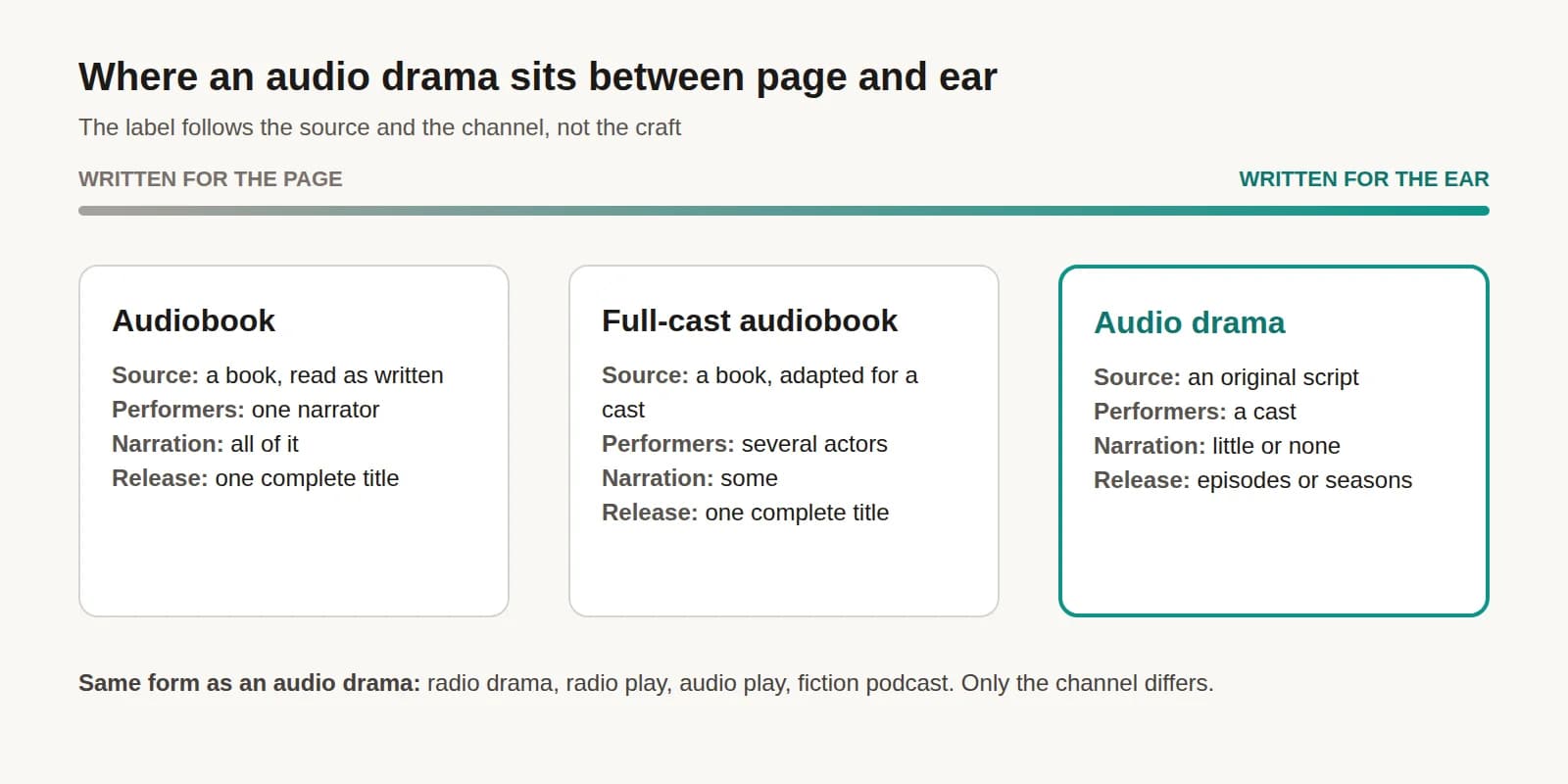
An audiobook is a recording of a book read aloud, usually by one narrator and usually unabridged. An audio drama has no page version. Its script is built from scenes, dialogue, and sound cues, the way a screenplay is built for a camera.
| Audiobook | Full-cast audiobook | Audio drama | |
|---|---|---|---|
| Source | A book, read as written | A book, adapted for a cast | An original script |
| Performers | One narrator | Several actors, often plus a narrator | A cast, often no narrator |
| Narration | All of it | Some | Little or none |
| Music and effects | Rare | Common | Central |
| Release | One complete title | One complete title | Usually episodes or seasons |
The full-cast audiobook is the blurry case. Heavy adaptation, where narration is cut and scenes are rewritten so dialogue carries them, produces something close to an audio drama based on a book. A store listing that says "dramatized adaptation" usually means the text was changed and is not the complete book.
For an independent creator, the practical difference is rights. An audio drama needs only your script, while an audiobook or adaptation of someone else's book needs their permission first.
Can you turn a book into an audio drama?
Yes, by rewriting it as a script first:
- Break the book into scenes, each with a place, a time, and two or three speaking characters.
- Move description into dialogue and sound. "The storm had been building all afternoon" becomes wind under the scene and a character saying, "It's getting worse."
- Drop interior monologue, or keep a narrator for the key moments.
- Mark performance: where a line is whispered, where a character hesitates.
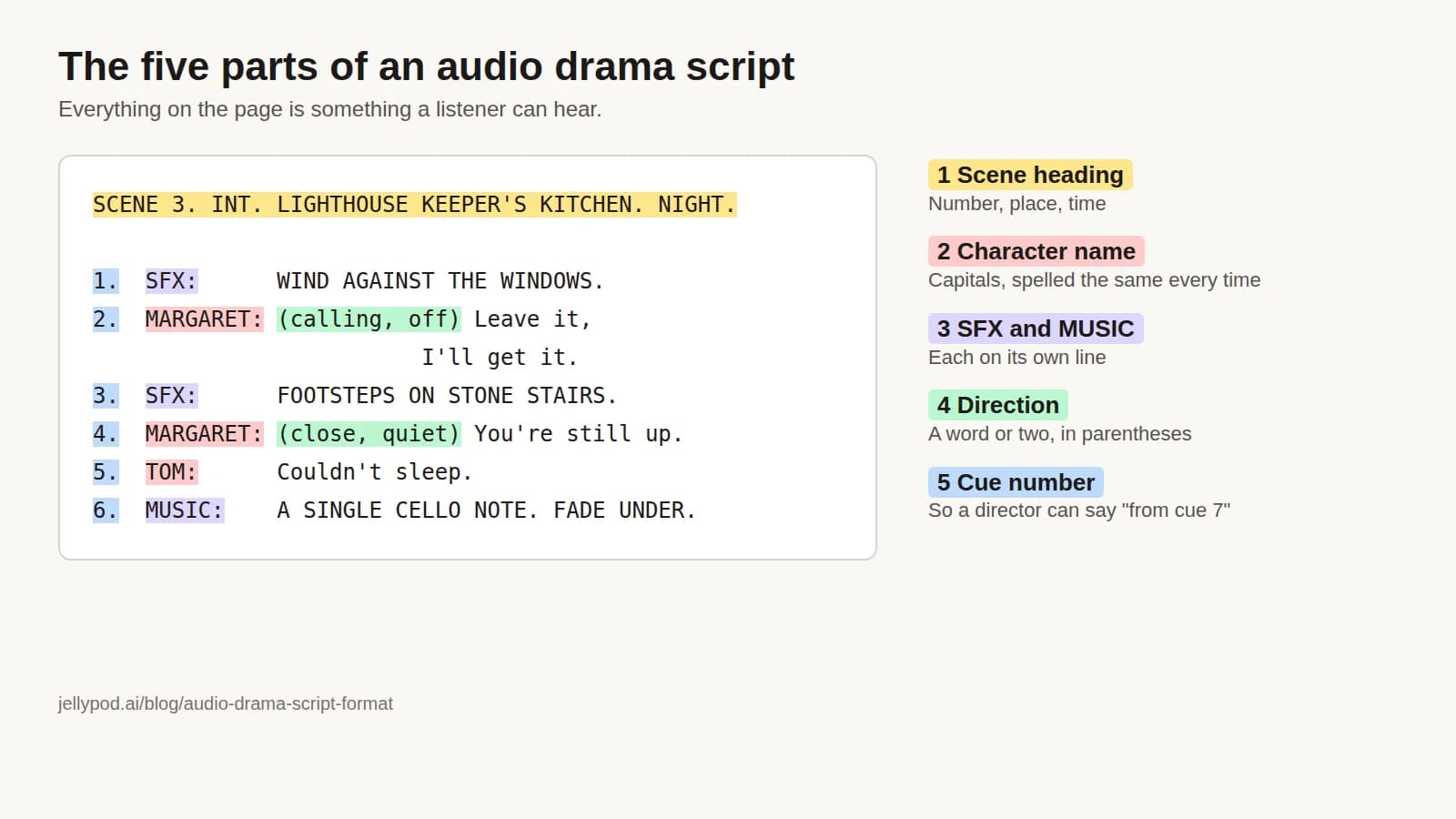
The audio drama script format guide shows how to lay out the pages. In Jellypod, a script with a named speaker on each line imports directly, each speaker is matched to a character, and audio tags such as whispers, gasps, and pauses direct the delivery.
What makes a good audio drama?
Four habits matter more than genre or budget.
Open every scene with a sound. The first second tells the listener where they are: rain and a kettle, or a crowd and a siren.
Make characters easy to tell apart. Listeners have only voice, accent, rhythm, and word choice, so two similar voices in one scene blur within a minute. Keep to two or three speakers per scene.
Let dialogue carry what a camera would show. Characters name each other and react out loud to what they see. Good writers hide this so it does not sound like exposition.
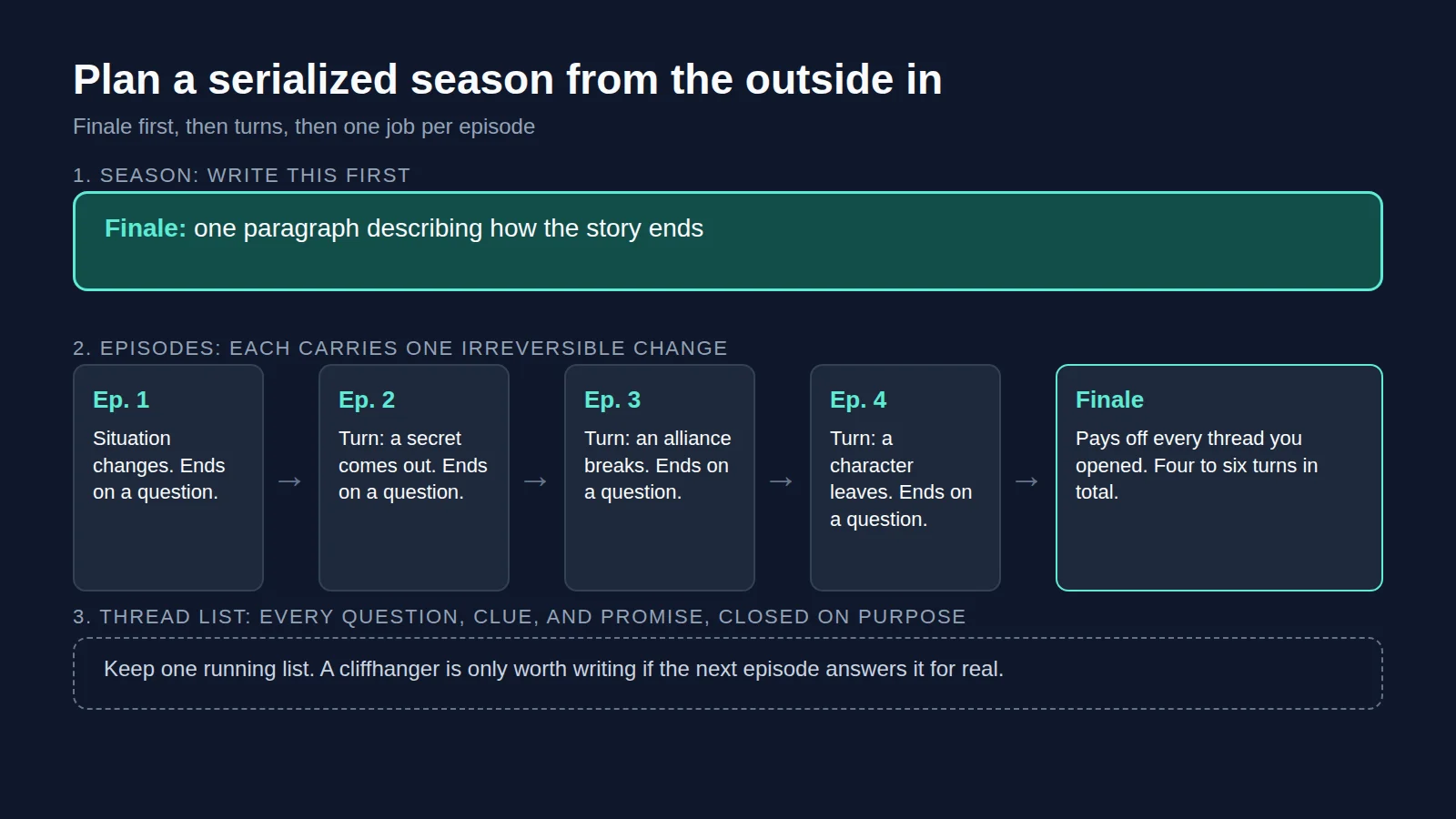
End on a question. In a serial, each episode should close on something the next one answers. See how to plan a serialized audio drama for season and episode arcs.
How do you make an audio drama today?
The traditional route means casting actors, scheduling recording sessions, and a sound designer assembling the mix, which can take weeks per episode. AI voices replace the recording step. The writing is still yours.
In Jellypod the workflow starts on the audio drama maker page. From there the steps are:
- Write the script, or describe the story and edit the AI draft.
- Create each character once, with a backstory and a voice from the library (3,300+ voices across 121 languages), a designed voice, or a clone of your own.
- Direct lines with audio tags, then regenerate any single line that misses. Regenerating audio is free.
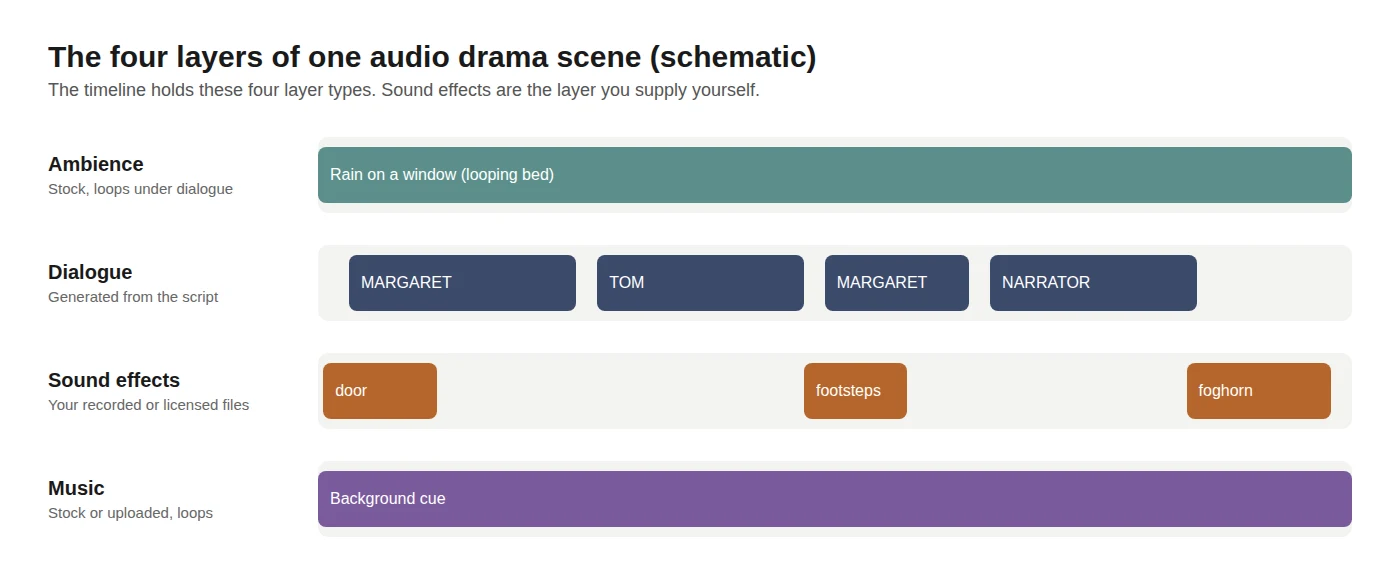
- Add music, looping ambience, and your own recorded or licensed sound effects on the timeline.
- Publish through your podcast's RSS feed to Spotify, Apple Podcasts, and YouTube.
Credits are spent on first generation at 30 credits per minute of audio. Starter includes 5,000 credits a month, about 166 minutes, and episodes can run up to 60 minutes. The full walkthrough is in how to make an audio drama, and the audio drama maker page features Zero Day, a series made and published with Jellypod.
If your story fits in about a minute per episode and a vertical feed, the micro drama maker makes illustrated, voiced episodes instead of audio-only ones.
Frequently asked questions
Is radio drama still made today? Yes. Broadcasters still commission radio plays, and independent producers release new audio dramas as podcasts every week. Most new work reaches listeners through podcast apps.
Is an audio drama the same as a podcast? A podcast is a way of distributing audio. Many audio dramas are released as podcasts, but not every podcast is an audio drama, and an audio drama can also be a CD, a download, or a broadcast.
Can one person make a full-cast audio drama? Yes. You still need a script and distinct voices, but AI voices let one writer cast and direct every part.
The short version
An audio drama is a story written and performed for the ear, and today it mostly lives in podcast feeds. If you have one to tell, start your first audio drama in Jellypod.