A serialized audio drama lives or dies on one thing: whether listeners feel they have to hear the next episode. That feeling is planned, not improvised.
To plan one, write the season ending first, break the story into four to six turns, give each episode one change that cannot be undone, and end each episode on a question the next one answers. Then keep your cast, facts, and release day consistent.
Consistency is the part that breaks first, and it is where Jellypod's audio drama maker helps: you save each character once, edit a season outline before anything is generated, and every episode is drafted from the full script of the one before it.
Key takeaways
- Write the season finale first, then list the four to six turns that get your characters there.
- Every episode needs one irreversible change. If you cannot name it, cut or merge the episode.
- A cliffhanger only works if the next episode pays it off for real. Fake-outs erode trust.
- In Jellypod, saved characters keep their voice, the series outline is editable before generation, and each episode is written from the previous full script.
- Pick a release day you can hold for the whole season, and finish several episodes before you launch.
What makes an audio drama serialized rather than episodic?
In a serialized drama, one story runs across episodes and listeners must hear them in order. In an episodic one, each episode resolves its own story and can be heard alone.
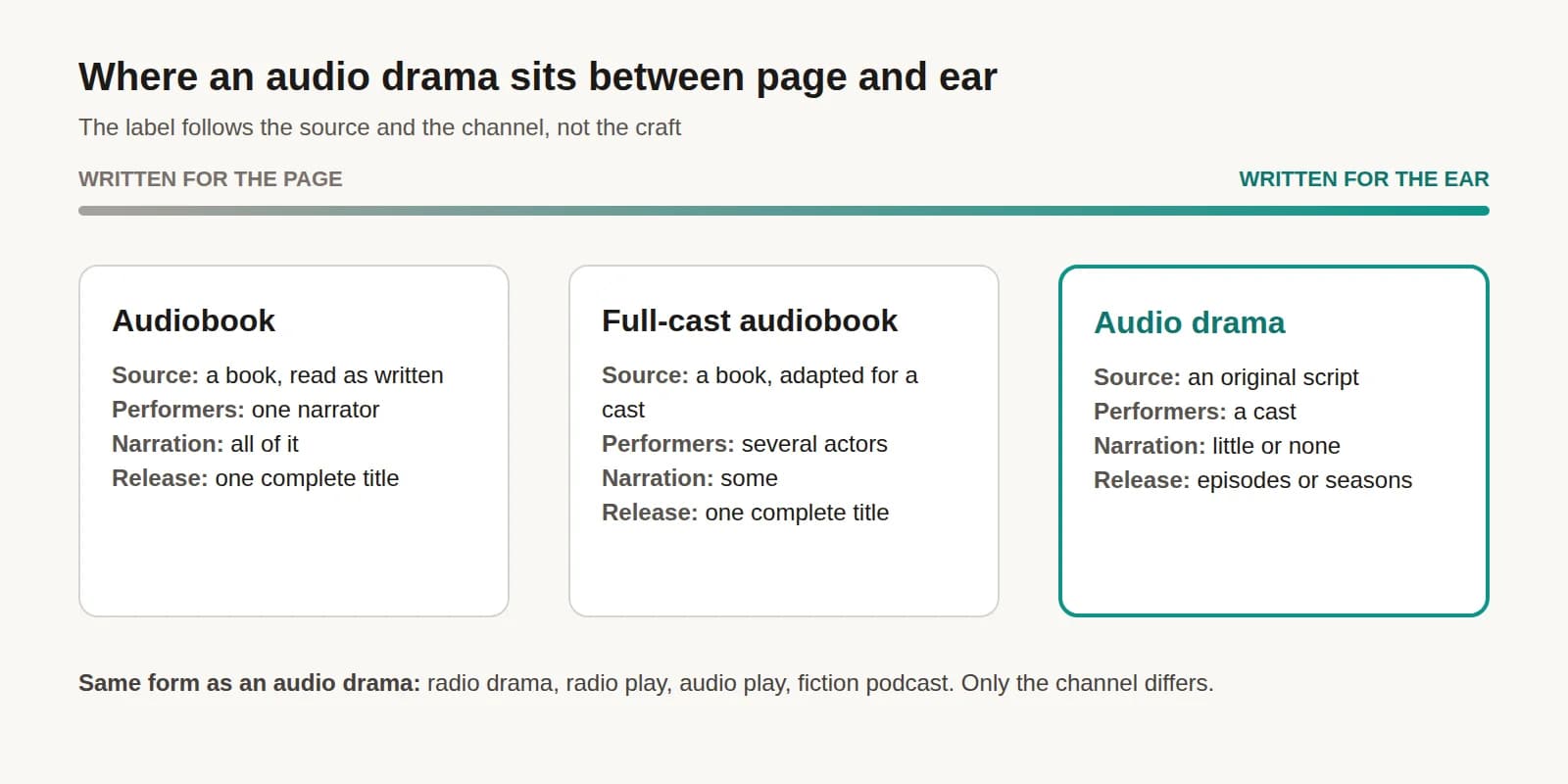
Most shows that hold an audience blend the two: each episode closes a smaller problem while a larger mystery runs through the season. New listeners get a complete episode, and returning listeners get a reason to stay. Decide early which side your show leans toward, because it changes how much recap every episode needs. For the basics of the form itself, see what an audio drama is.
How do you plan a season of an audio drama?
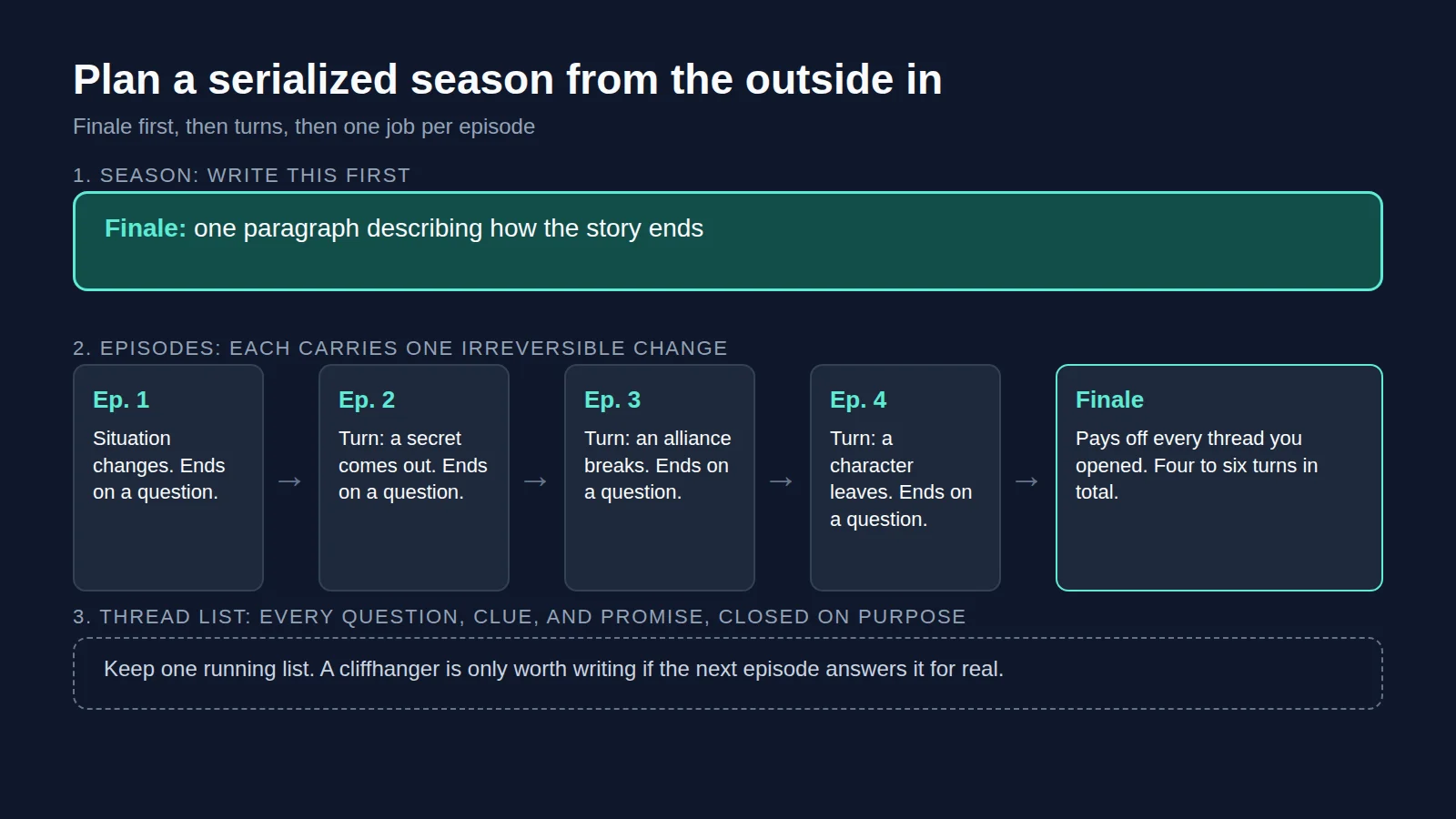
Plan from the outside in: season, then episode, then scene.
- Write the finale first. A one-paragraph summary of the ending keeps the middle from wandering.
- List four to six turns. A turn is a moment where the situation changes and cannot go back: an alliance breaks, a secret comes out, a character leaves.
- Give every episode one job, meaning one turn or one step toward it. If two episodes do the same job, merge them.
- Keep a thread list. Write down every question, clue, and promise you have made to the listener, and close each one on purpose. Unresolved threads are what listeners remember as sloppy writing.
- Write a character bible: how each person talks, what they know at this point in the story, and what they want. In audio, a voice is a face, and listeners notice when it drifts.
Jellypod's series planner follows the same shape. Describe the series, choose 2 to 8 episodes and a shared duration, and Jellypod returns an ordered outline with a one-sentence summary per episode. You can edit or delete any episode's detailed prompt before you click Create Episodes. A prompt that asks for several episodes directly (for example, "a five-part series") skips the review step and supports up to 10.
How do you write a cliffhanger that works in audio?
A cliffhanger ends an installment on an unresolved question. It does not need a literal danger, only a reason the listener cannot let the story sit. Four shapes cover most cases:
- The reveal: new information recasts what came before.
- The decision: a character must choose, and the episode ends first.
- The arrival: a footstep, a knock, or a voice we recognize. In audio, one sound can carry it.
- The reversal: the plan that seemed to work fails in the last line.
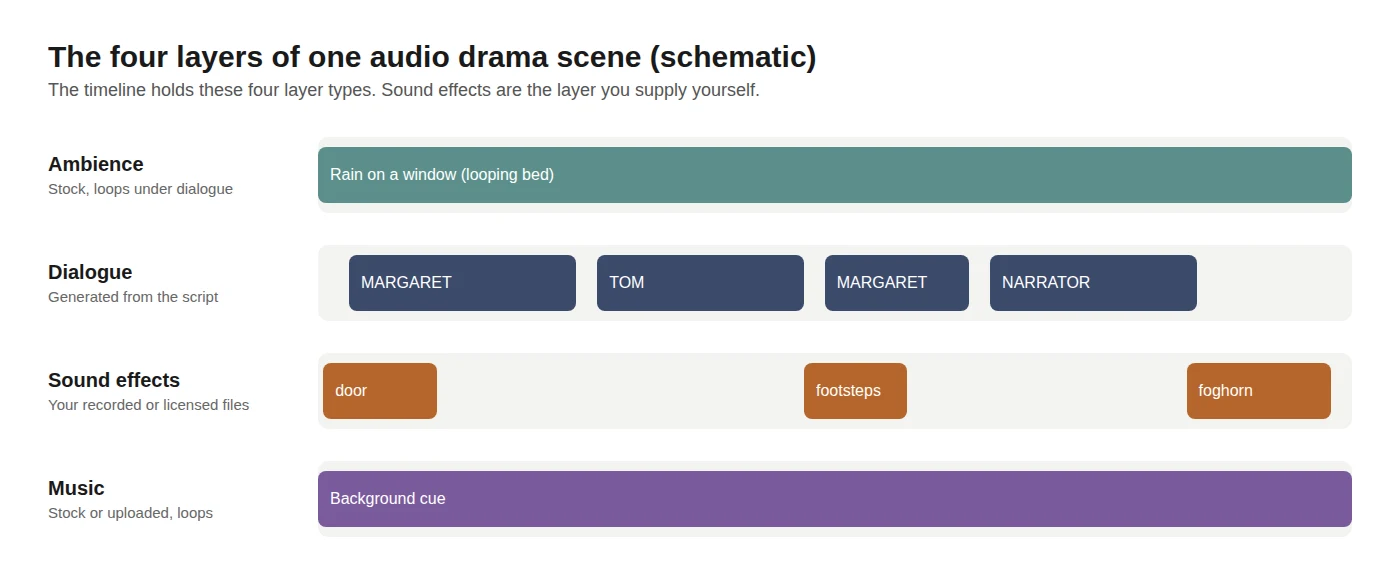
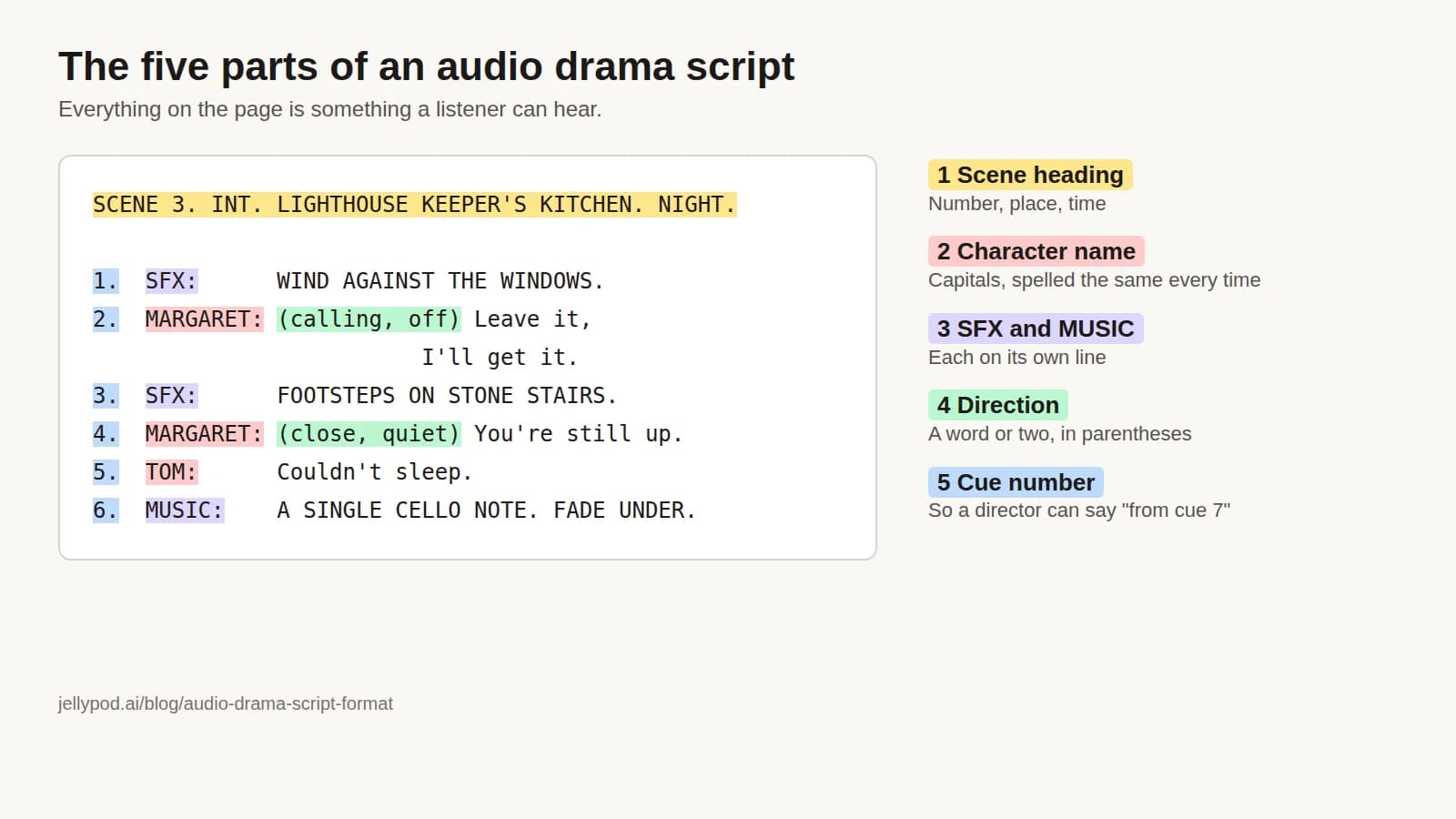
Audio adds its own tools. A line can hang with no reply, and music can cut out instead of resolving. In Jellypod you can mark the final line with audio tags such as whispers, pauses, or gasps so the voice lands the beat as written. Tags only work on voices whose model can perform them, and the script editor flags any that cannot. Jellypod does not generate sound effects, so a knock or a footstep is a file you drag onto the timeline yourself. For how to format those cues on the page, see audio drama script format.
Use the device sparingly. If the next episode undoes the hook in its first minute, listeners stop trusting it.
How do you keep characters and facts consistent across episodes?
The usual failure is quiet: a minor character's voice drifts, or a detail from episode three is contradicted in episode nine. Two habits help with any tool. Reread the previous episode before writing the next one, and open each episode with a brief recap in dialogue rather than narration.
Jellypod handles the mechanical part in three ways:
- Saved characters. Each character has a name, backstory, personality, and voice, and you reuse the same cast in every episode. An episode can have up to four speaking characters, and a narrator counts as one. Starter organizations can keep up to 10 saved characters, and Creator and above have no limit. See the AI character creator.
- Chained scripts. Research for every episode starts at once, but each script waits for the one before it. The writer receives the full previous script plus short summaries of older episodes, so names, facts, and open threads carry forward. If an earlier script fails, later episodes stop instead of writing over a gap.
- Editable output. Every line can still be edited or regenerated afterward, so you stay the author of the arc.
The limit to plan around: the outline planner takes 2 to 8 episodes per run. For a longer season, run it in batches and open the second batch with a short recap of where the first ended, since we have not documented that a later batch reads earlier ones.
How often should you release a serialized audio drama?
Pick a cadence you can keep for the whole season, weekly or every other week, and announce it. A regular day matters more than a fast one.
Two tactics make it sustainable. Launch with two or three episodes so new listeners have enough story to get hooked. Then finish a buffer of episodes before launch so a busy week never breaks the schedule.
In Jellypod, scheduling is on every paid plan: pick a future date and time up to 90 days out, and the episode publishes to your RSS feed and podcast website automatically. You can also group episodes into numbered seasons, with optional titles, which then appear in podcast apps and on your show's website. Season assignment is available once an episode is published or scheduled, not on drafts.
What does a serialized audio drama cost to produce in Jellypod?
Audio generation is 30 credits per minute, and drafting, editing, regenerating audio, publishing, and downloading are free. A 15-minute episode costs 450 credits, so an eight-episode season at that length is 3,600 credits. Starter includes 5,000 credits a month, and episodes can run up to 60 minutes on every plan. Fixing a mispronounced line by regenerating it costs nothing, which makes revising a cliffhanger cheap.
Frequently asked questions
Should every episode end on a cliffhanger? No. Every episode should end with a reason to continue, which can be a quiet question as easily as a shock.
How long should a season be? Long enough to reach the finale you wrote first. Count the turns needed to get there, at one to two episodes each.
Can AI write a serialized story? It can draft episodes, but the finale, the turns, and the choices about what matters should stay yours. That is why the Jellypod outline is editable before generation.
To build your own, start with the step-by-step audio drama workflow, then set up your series in Jellypod. If your series needs several voices in conversation, multi-host voices covers how to cast them.