
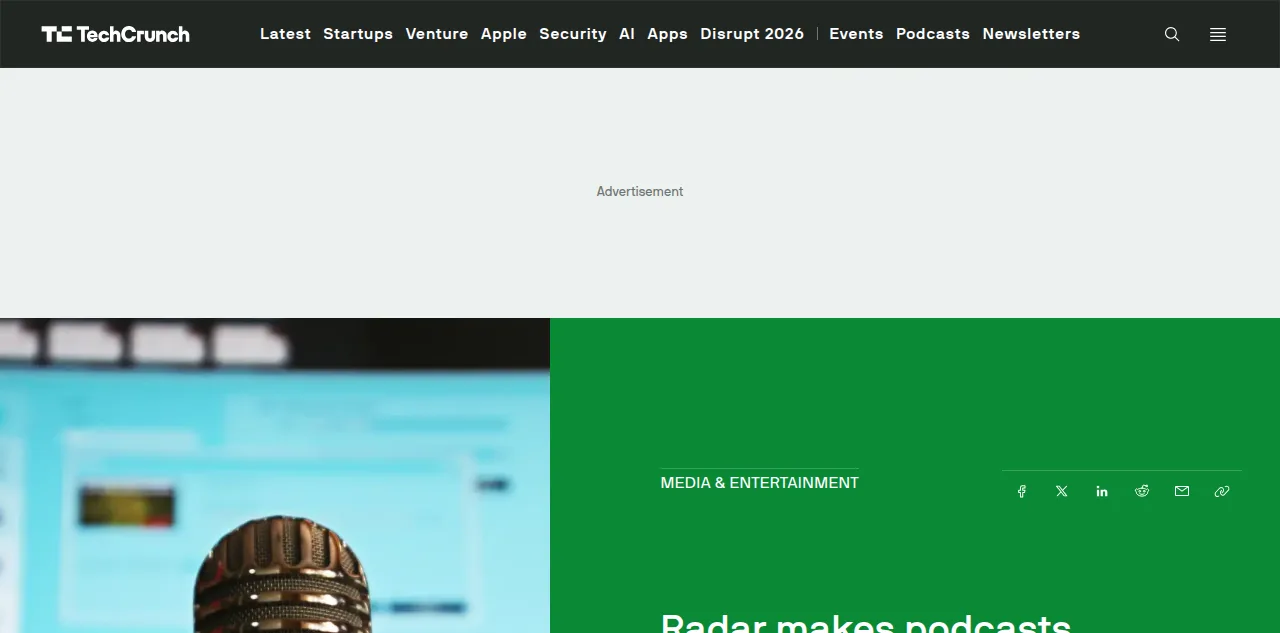
Radar launched on August 26, 2026, and it treats a podcast the way a database treats a table: something you query, not something you sit and listen to. Type a question, and an AI agent returns a cited answer pulled from inside an episode.
Particle, the startup behind it, transcribes and indexes more than 130,000 shows, including every one of Apple's Top 200 across 135 verticals, adding roughly 20,000 new episodes a day. Jellypod ships every episode with the two things that make a show queryable this way: a full transcript and a public episode page, generated by default instead of bolted on after the fact. Across Jellypod's published shows right now, roughly three in four episodes carry a live transcript page, the exact asset an indexer like Radar has to build from scratch for everyone else.
Radar's highest-volume customers are not podcast fans. They are hedge funds.
What is Radar, and why did a startup build a search engine just for podcasts?
Radar is a podcast intelligence platform from Particle, a company founded by former Twitter engineers and led by co-founder and CEO Sara Beykpour. It transcribes audio, tags speakers, and extracts entities (people, companies, topics) from each episode, then exposes all of it through an API and a Model Context Protocol (MCP) server so AI agents can query it programmatically.
Beykpour's stated reason for building it doubles as the whole thesis of this article: "Agents are generally blind to audio; they can't see it unless something or someone has transcribed it," she told TechCrunch.
The customer list gives that thesis a price tag. Hedge funds are Radar's highest-volume API users, running research agents against earnings-call podcasts and industry shows that never got transcribed anywhere else. AI search platforms and data resellers are next, followed by journalists and researchers. Individual access starts at $29 a month, a business plan with 20 seats runs $399 a month, and API pricing is custom. Particle plans to extend the same model to YouTube and news clips next.
Why can't AI agents just "hear" a podcast?
Because an agent, like a search engine, reads. It does not listen.
Text is the interface every large language model was trained to consume. An MP3 file has no words in it that a model can tokenize, only a waveform. Someone, or something, has to turn the audio into text before an agent can search it, quote it, or cite it in an answer. That is the entire service Radar sells: transcription and indexing at a scale most shows can't or won't do themselves.
Podcasts have had this problem for years. It's the same one that has kept them out of Google search results, covered in detail in how podcast SEO works. Radar proves the problem now has a second buyer beyond Google: the agent economy, with hedge funds paying a subscription to solve it.
How do AI agents and answer engines actually find podcast content?
They find the transcript, not the show.
Google's AI Overviews, ChatGPT search, Perplexity, and now Radar's own agent-facing API all work the same way at the mechanical level: they index text, match it against a query, and surface the passage that answers it best. None of them parse raw audio at query time. B2B teams are already using this to get quoted in AI answers for questions their episodes actually cover, because a transcript turns forty-five minutes of audio into a page with thousands of indexable words.
MCP, the protocol Radar uses to expose its data, is the newer piece. Anthropic introduced it as an open standard so an AI agent could call a live tool instead of only reading a static page, the same way a USB-C port lets one plug fit many devices. A podcast reachable over MCP isn't just crawled once and cached. It's queryable in real time, which is exactly what a hedge fund's research agent needs when it's asking "what did this CEO say about supply chains in the last three earnings-call recaps."
What actually makes a podcast episode ready for AI agents?
Three things, in order of how much each one matters.
| Requirement | What it does | Who has it by default |
|---|---|---|
| A full transcript | Turns audio into indexable, quotable text | Jellypod episodes, Radar-indexed shows |
| A public, structured episode page | Gives the transcript a URL agents and crawlers can reach | Shows with their own podcast website |
| Programmatic access (API or MCP) | Lets an agent query and act, not just read once | Radar subscribers, Jellypod's MCP server |
Most independent shows have none of the three. They record, export an MP3, upload it to a host, and stop. No transcript means no text for anything, human or agent, to search. Even shows that do add captions or a transcript often leave it inside a video file or a PDF that never gets its own indexable page.
Does Jellypod do what Radar had to build?
For its own shows, yes, and it shipped before Radar did.
Every episode generated on Jellypod gets a full transcript and a public episode page automatically, the same mechanism podcast SEO depends on. That's where the "three in four episodes have a live transcript page" figure above comes from: an aggregate count across every published episode on the platform, not a projection.
Jellypod also runs its own remote MCP server at mcp.jellypod.com, open on every plan since June 2026. Connect Claude, ChatGPT, Perplexity, or Cursor to it, and that assistant can read your podcast and episode analytics and pull a transcript as JSON, SRT, or VTT, the same shape of access Radar sells hedge funds for other people's shows. A Jellypod creator's agent gets that access at no extra cost, over an account they control, instead of a third-party index recrawling their audio for them.
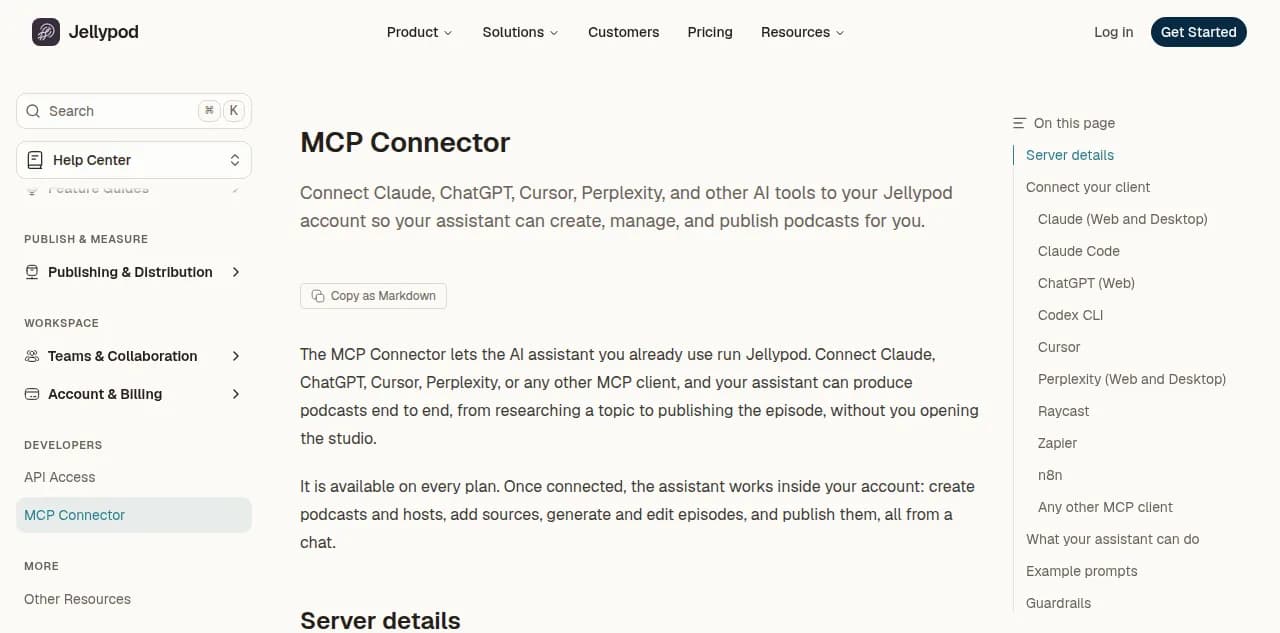
Radar had to build transcription and an agent-facing API as a $29-a-month product because most podcasting tools never gave creators either one. A podcast made on Jellypod ships both by default. The MCP Connector and the developer resources hub cover the setup if you want your own assistant reading your show today.
Frequently asked questions
What is Radar, Particle's podcast search tool? Radar is an AI-agent-facing search engine that transcribes and indexes podcasts. It launched August 26, 2026, covers more than 130,000 shows including Apple's Top 200, and exposes the data through an API and an MCP server so agents can query episode content the way they'd query a database.
Do AI answer engines like ChatGPT or Perplexity actually read podcast transcripts? Yes. They index text, not audio, so a transcript is what makes an episode eligible to be quoted in an AI-generated answer. An episode with no transcript is functionally invisible to every answer engine, regardless of how good the audio is.
How do I make my podcast readable by AI agents without paying for a service like Radar? Publish a full transcript on a public, indexable episode page for every episode, and expose that content through an API or MCP server if you want agents to query it directly rather than only crawl it. Jellypod does the first two automatically for every episode and offers the third through its own MCP server at no added cost.
Does every podcast need Radar to be found by AI agents? No. Radar exists because most podcasting tools leave transcription and agent access up to the creator. A show that publishes transcripts on indexable pages, or connects an MCP server, is agent-readable without a third party doing it for them.
The short version
Radar proved AI agents will pay to read podcasts that were never built to be read. A transcript on a public page fixes that, and increasingly, so does a live connection an agent can query directly. Jellypod ships both with every episode.