A content factory is a system that turns a steady stream of inputs into finished content on a fixed schedule and in a fixed format. You design the show once. The factory makes every episode after that.
Marketing teams used the term for years to describe an in-house production desk. AI changed what one looks like. One person can now run a factory that writes, voices, illustrates, and publishes videos, shorts, and podcasts. In the last 30 days, Jellypod creators made 5,579 podcast Episodes and 4,335 Videos, Shorts, and Voiceovers.
Key takeaways
- A content factory has five parts: inputs, a fixed format, a production line, a review step, and distribution.
- It borrows its design from the software factory, where AI agents write and test code, and swaps automated tests for a person who reviews the first drafts.
- Jellypod Automations have run 3,304 times since they launched on April 28, 2026, and have made 3,011 Episodes. 75% of those Episodes are published.
- Most factories run weekly: 56% of scheduled Automations run once a week and 20% run every day.
- A run takes a median of under four minutes from trigger to finished Episode.
- The busiest Jellypod organization ran 373 automated runs in the last 30 days, about 12 a day.
What is a content factory?
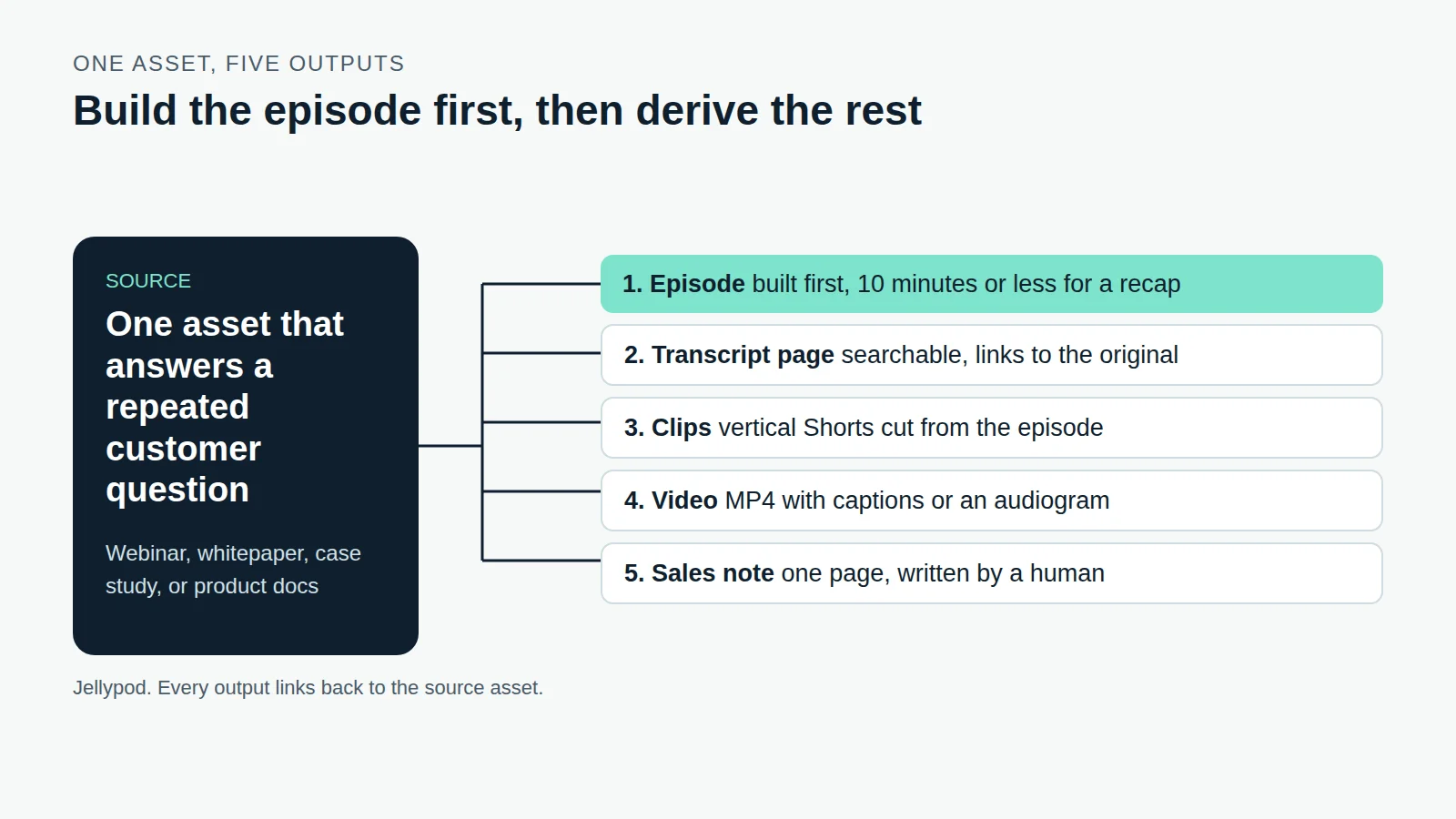
A content factory is a repeatable production system for content. It takes raw material, such as news, research, newsletters, and product updates, and runs it through the same steps every time to make finished videos, shorts, and podcast episodes.
Three traits separate a factory from a busy content team:
- It runs on a schedule. Output arrives daily or weekly whether or not anyone remembers to start it.
- The format is fixed. Length, style, voice, and branding are set once and reused on every piece.
- The work is split into stations. Research, script, voice, visuals, and publishing each happen in a known order.
An AI content factory hands most of the stations to software, so one person can run what used to need a writer, a narrator, an editor, and an animator.
Content factory vs software factory
The factory idea comes from software. Hitachi opened the first software facility managed as a factory in 1969, built on standard tools, reusable parts, and measured quality. AI coding agents brought the term back in 2026. StrongDM's software factory runs on two rules: code must not be written by humans, and code must not be reviewed by humans. At OpenAI, Codex wrote every line of an internal product, and the engineers built the environment the agents work in.
A content factory applies the same design to videos and podcasts.
The quality gate differs most. A software factory checks its own work: StrongDM's agents run thousands of end-to-end scenarios an hour against copies of the services its software uses. A video has no test suite, so a person reviews the first drafts, fixes them, and tightens the prompt until runs need no edits. In both factories, the person's job moves from making each piece to designing the line and checking what comes off it.
The five parts of a content factory
1. Inputs
A factory needs a reliable supply of raw material. Good inputs change every run while the topic stays the same: the day's news in your industry, each new issue of your newsletter, a weekly product changelog, and the questions customers ask.
In Jellypod, an Automation works from a standing prompt that every run follows. An Inbound Email Automation also uses each email it receives as a Source.
2. A fixed format
The format is the mold every piece comes out of. Decide it once:
- Output: podcast Episodes, horizontal Videos, and vertical Shorts, one kind per Automation.
- Length: Episodes run 3 to 60 minutes.
- Look: one visual style, one narrator, and one Brand Kit with your logo, colors, and fonts.
3. A production line
The production line turns an input into a finished piece. For an AI video or podcast, the stations are research, script, voice, visuals, captions, and render. Jellypod runs the whole line on every Automation run, with the same pipeline as content you start by hand.
4. A review step
A factory needs a quality check before anything ships. Episode Automations can save every run as a draft for review, and Video and Short Automations always save a private result to your Videos library. Open the script editor to fix a line and regenerate only that line.
When the drafts stop needing edits, turn on Auto-Publish for Episodes and let the factory ship on its own.
5. Distribution
Jellypod hosts your podcast and sends it through RSS to Spotify, Apple Podcasts, and YouTube. Videos and Shorts publish straight to YouTube, and to Instagram, TikTok, LinkedIn, and X through Buffer.
What a content factory looks like in real data
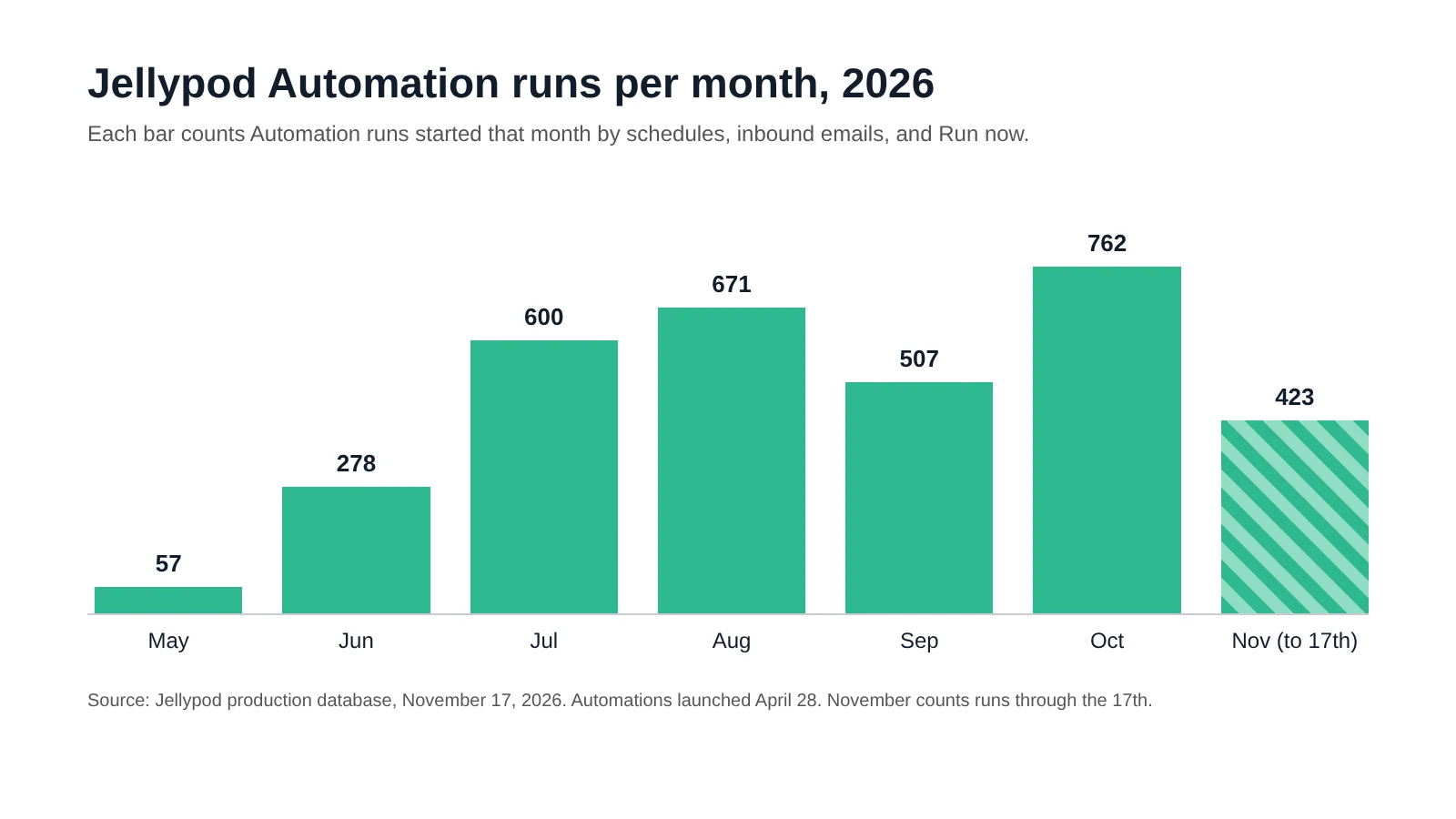
We pulled these numbers from the Jellypod production database on November 17, 2026.
More than half of scheduled factories run one day a week, which leaves time to review each draft. Monthly runs grew from 57 in May to 762 in October.
Video volume is concentrated too. In the last 30 days, 68 organizations made 10 or more Videos and Shorts, and the busiest made 180. Whiteboard is the most-used style, at 47% of the 9,565 Videos, Shorts, and Voiceovers made in Jellypod, followed by Stickman and Paper Mache.
How to build a content factory with Jellypod
- Pick one show. Name the audience and the promise, such as "a five-minute daily briefing on AI product launches."
- Make the first piece by hand. Tune the style, narrator, and length in Videos, Shorts, and the AI podcast generator until you would publish the result.
- Open Automations and click New Automation. Choose the same output and a trigger. Schedule runs on set days, and Inbound Email runs on each email it receives.
- Write the standing prompt. Describe what every run covers. "Cover the most important AI product launches from the past day" works every morning.
- Set the schedule. Pick the days, time, and timezone. The preview lists the next runs, and the Content Calendar shows them beside your published Episodes.
- Review the first week of drafts. Edit what needs fixing, then tighten the prompt so the next run needs less.
- Connect distribution. Turn on Auto-Publish for Episodes, and connect YouTube and Buffer for Videos and Shorts.
To trigger runs from other apps, connect Jellypod to Zapier through the MCP connector, so new sheet rows, blog posts, and form submissions start Videos and Episodes.
Content factory vs content farm
A content farm publishes volume for its own sake. A content factory publishes one consistent show, and each episode starts from a real source, such as fresh news, a new newsletter issue, and customer questions. Google's spam policies target pages made at scale with little value to readers, so keep a real input and a review step in every factory.
Frequently asked questions
What is an AI content factory?
An AI content factory is a content factory where software runs most of the production line. It researches, writes, voices, illustrates, and publishes each piece from a saved prompt and format, and a person reviews the output.
What is the difference between a content factory and a software factory?
Both run work through a fixed line of stations on a steady stream of inputs. A software factory turns specs into shipped code and checks it with tests. A content factory turns prompts and sources into videos, shorts, and podcasts, and a person reviews the drafts.
How much content can one content factory make?
As much as your inputs and credits support. On Jellypod, an inbound email Automation can run up to 10 times a day, and the busiest organization ran 373 automated runs in the last 30 days. Each run spends credits at the same price as content you start by hand.
Do I need a team to run a content factory?
No. One person can run a Jellypod content factory. Set the format once, review the first drafts, and let the schedule handle the rest. Teams can share Automations, Brand Kits, and Channels across an organization.
What should a content factory make first?
Start with one weekly show built on an input that changes every week, such as industry news or your own newsletter. Add a daily Short once the first show runs without edits.
Build your content factory with Jellypod AutomationsTry Jellypod