Most faceless channels stall at the same place. Shorts are easy to produce and almost impossible to earn from, so the channel grows a view count and no revenue.
A long-form faceless video is an 8 to 20 minute narrated video with no one on camera, built from a script rather than footage. You write or generate the script, produce the narration, generate scenes that track what the narration is saying, and upload the MP4 yourself. Jellypod does the middle of that: one source in, and it renders the narration and the matching visuals together as a single 1080p file with word-synced captions, up to 25 minutes of narration depending on your plan.
The reason to bother is arithmetic. From February 1, 2027, YouTube's new Partner Program thresholds ask new creators for 8,000 qualified watch hours in 365 days or 20 million qualified Shorts views in 90 days. A weekly long-form channel can reach the first on ordinary numbers, while the second asks for a scale most channels never see.
What counts as long-form on YouTube?
Anything past the Shorts ceiling. YouTube Shorts can run up to 3 minutes, so a video of 3 minutes and one second is long-form as far as the platform's formats are concerned.
In practice the useful definition is longer than that. A video needs enough duration to accumulate watch time and to carry mid-roll ads, which is where the revenue difference comes from. Most faceless explainers land between 6 and 15 minutes. Below about 5 minutes you are producing something with the effort profile of long-form and the earning profile of a clip.
There is no upper cap on YouTube's side. The practical cap is whether the script holds attention, and a tight 8-minute video beats a padded 20-minute one on every metric that matters.
Why make long-form instead of Shorts?
Because the two formats reach the same monetization door at wildly different costs, and YouTube's own numbers show it.
The current thresholds are 1,000 subscribers plus either 4,000 qualified watch hours in 12 months or 10 million qualified Shorts views in 90 days. From February 1, 2027 those move to 8,000 watch hours or 20 million Shorts views for new creators, with existing Partner Program members grandfathered in.
Work out what each route actually asks for:
| Route | What it requires | What that means in views |
|---|---|---|
| Watch hours | 8,000 hours in 365 days | About 96,000 views of a 10-minute video at 50% average view duration |
| Shorts views | 20 million in 90 days | About 222,000 views every day for three months |
Publishing weekly, the watch-hour route works out to roughly 1,850 views per video. That is an ordinary number for a channel finding its niche. The Shorts route asks for a scale most channels never reach.
The revenue gap runs the same direction. Mediacube puts Shorts ad revenue at roughly $0.01 to $0.05 per 1,000 views across 2025 and 2026, against dollars per thousand on long-form, where a viewer sits through pre-roll and mid-roll ads rather than a shared feed ad. Publish Shorts to get found, and treat the long-form uploads as the thing the channel actually sells.
How do you make a long-form faceless video with AI?
The workflow is five steps, and only the first and last need you.
- Decide what this specific video argues. Not the topic, the claim. "Why the Concorde failed commercially" is a video. "Concorde facts" is a template.
- Get the script to length. A 10-minute narration runs roughly 1,400 to 1,600 words. Draft it yourself, or start from a source document, a URL, or a YouTube link and edit what comes back.
- Generate narration and scenes together. In Jellypod this is one pass: pick a voice from over 100 across 70 or more languages, or use a clone of your own, then choose a Video style. The scenes are generated against the same script that drives the narration, so they stay in sync without a timeline edit.
- Export the MP4. 1080p, landscape 16:9, portrait 9:16, or square 1:1, no watermark, and the file is yours.
- Upload it in YouTube Studio. There is no direct publish to YouTube, so the last step is manual, which also means you set the title, thumbnail, chapters, and disclosure by hand.
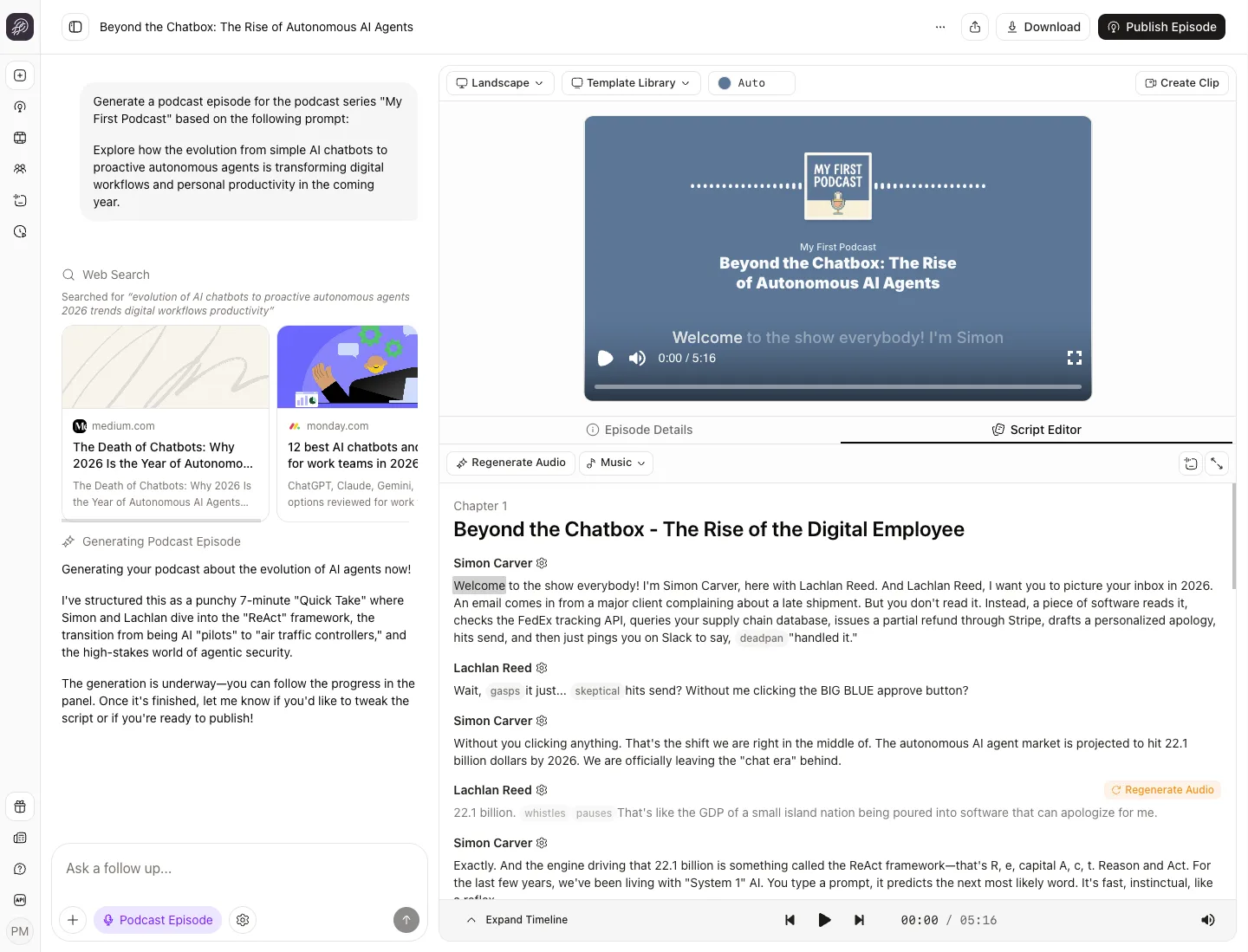
The plan limits matter here, so plan the length before you write. Magic Video covers up to 10 minutes of narration on Starter and Educator, 15 on Creator, and 25 on Business, per the plans and pricing page. Episodes longer than your plan's ceiling still render as video, using the Karaoke template rather than generated scenes.
How do you hold retention across ten minutes?
By making sure every minute advances the argument. Watch hours, not views, are what the Partner Program counts, so a video that sags in the middle costs you the exact thing you added the length for.
Three habits do most of the work:
- Open with the claim, not the preamble. Say what the video will establish in the first fifteen seconds. Channel intros and "before we begin" throat-clearing are where the steepest drop-off happens.
- Change something every ninety seconds. A new scene, a new sub-question, a number the viewer did not have. Generated visuals help here because the scene changes track the script rather than a fixed interval.
- Cut any section you could delete without weakening the claim. If the argument is finished at seven minutes, publish seven minutes. Padding to hit a length target trades retention for duration and usually loses both.
For how long the video should run in the first place, and how that fits alongside Shorts in a weekly cadence, see how to make a faceless YouTube channel.
What breaks when you stretch a short-form workflow to long-form?
Three things, and each one gets worse the longer the video runs.
Visual repetition. A 30-second clip needs three or four scenes. A 12-minute video needs dozens, and the generation has to keep producing distinct ones rather than cycling the same handful. Repetition across a long runtime is exactly the pattern YouTube's monetization policy flags.
Script drift. Short scripts hold a single idea. Long scripts have structure, and generated ones tend to restate the opening instead of advancing. The fix is editorial: read the draft and cut anything that repeats a point already made.
Audio and visual sync. Over 30 seconds a manual timeline alignment is tedious. Over 12 minutes it is the whole job, and it has to be redone every time the script changes. Generating both from one script is what makes long-form practical rather than merely possible.
Plan for all three by treating the script as the source of truth and everything downstream as regenerable. Edit the words, not the timeline.
Will a long AI-generated video still get monetized?
Yes, as long as it is not templated. Eligibility turns on how much each video varies from the last one, not on how long it runs, and YouTube's inauthentic content policy asks that "the substance of each video should be materially varied."
Length works in your favor here. A 12-minute video has room to make an argument that no other video on the channel makes, which is the variation the policy looks for. The risk sits in the opposite format, where fifty near-identical clips are far easier to produce than fifty distinct essays. For what the policy rules in and out across a whole channel, see how YouTube automation actually works.
One extra step applies to synthetic narration. If the voice or footage is realistic, flag it with the altered content setting in Studio under YouTube's disclosure policy; a stock voice or a clone of your own generally does not require it.
Frequently asked questions
How long can an AI-generated video be? In Jellypod, Magic Video covers narration up to 10 minutes on Starter and Educator, 15 on Creator, and 25 on Business. Episodes past your plan's ceiling still render as an MP4 using the Karaoke template instead of generated scenes.
How many words is a 10-minute video script? Roughly 1,400 to 1,600 words at a normal narration pace. Write to that target rather than to a page count, and read it aloud once before generating, since narration exposes sentences that only work on the page.
Do long-form faceless videos earn more than Shorts? Substantially, per view. Shorts ad revenue runs at cents per thousand views while long-form runs at dollars, because long-form carries pre-roll and mid-roll ads against a viewer who stays for minutes rather than seconds.
Can I publish straight to YouTube from Jellypod? No. You download the finished MP4 and upload it in YouTube Studio yourself. That keeps the title, thumbnail, chapters, and AI disclosure settings in your hands.
Does a longer video always earn more? No. Watch time is length multiplied by retention, so a 20-minute video that loses most viewers at minute four earns less than a tight 8-minute one. Add length only where it carries more argument.
The short version
Long-form is where a faceless channel earns, and YouTube's February 2027 thresholds make that gap explicit: 8,000 watch hours is a reachable number, 20 million Shorts views is not. Write a script that argues one specific thing, generate the narration and scenes from it in a single pass, and upload the file yourself. Generate a sample video free and see the output before you plan a channel around it.