
An AI accent generator turns written text into speech in a specific regional voice: British, Australian, Indian, Irish, dozens more. It sounds like a novelty until you look at who actually reaches for one.
Across roughly 160,000 active podcast hosts built on Jellypod, an AI Podcast Studio, just under half are voiced with something other than a default American accent. British and Australian accents alone cover more than 4 in 10 shows on the platform. Nobody is picking these voices as a joke. An education show about British literature sounds right in a British accent. A brand targeting Sydney sounds right in an Australian one. The accent is doing narrative work, not decoration.
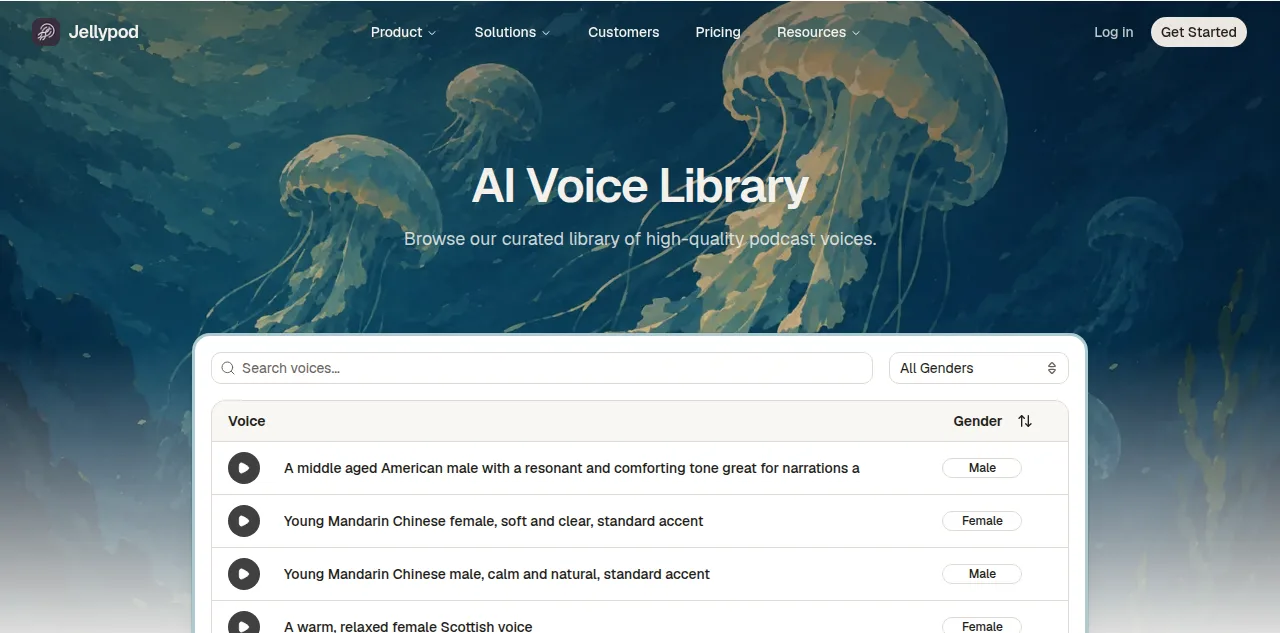
Jellypod's voice library lets you browse dozens of accents by gender and description, preview a sample, and cast one as a podcast host in a couple of clicks, the same workflow whether you are scripting an episode from a PDF or a lecture.
What the accent data actually looks like
The breakdown, pulled from active (non-guest) hosts across the platform:
| Accent choice | Share of hosts |
|---|---|
| Non-American accent (any) | About 47%, just under half |
| British | About 1 in 4 |
| Australian | Nearly 1 in 5 |
| British + Australian combined | More than 4 in 10 |
| Indian | Roughly 1%, with dozens of other accents making up the rest |
The long tail matters as much as the top of the list. Beyond British and Australian, hosts on Jellypod are cast with Irish, South African, Indian, Brazilian, Scottish, Singaporean, and more than a dozen other accents. A platform built for one default voice would not produce a distribution this wide.
What is an AI accent generator?
An AI accent generator is text-to-speech software trained to produce a specific regional pronunciation pattern: vowel shifts, rhythm, and intonation associated with a place, on top of whatever script you feed it. Type a sentence, pick British, Australian, or Indian, and the output reads in that accent without you recording anything yourself.
The distinction that matters is between an accent and a voice clone. A clone recreates one specific person's voice. An accent generator applies a regional speech pattern to a synthetic voice that was never modeled on a real, identifiable person. For creators, that difference is also the legal and ethical line: casting an AI host with an Australian accent is not impersonating an Australian person, the same way a voice actor doing an accent on a commercial is not impersonating anyone.
How does AI generate a realistic accent?
Modern text-to-speech models learn accents the way they learn everything else: from paired audio and text, at scale, across thousands of speakers who share a regional pattern. The model does not memorize one person's voice. It learns the statistical shape of how a region pronounces vowels, stresses syllables, and paces sentences, then applies that shape to any script and any voice built on top of it.
Quality has moved fast in 2026. Speechify's Simba 3.2 model took the top spot on the independent Artificial Analysis speech leaderboard in July, ahead of models from ElevenLabs, OpenAI, and Google DeepMind, on a blind-listener benchmark that neither company runs itself. That kind of third-party, blind evaluation is the right way to judge whether an accent actually sounds natural, rather than trusting a vendor's own claim.
Which AI accents sound the most natural right now?
Broad, widely-spoken accents (British, Australian, general American) sound the most consistently natural, because models have the most training data for them. Regional and minority-language accents are catching up fast, and the clearest recent example is not even a podcast tool.
In July 2026, Google Maps shipped a new navigation voice built specifically to pronounce New Zealand place names correctly, developed with Te Taura Whiri i te Reo Māori, the Māori Language Commission. Instead of mangling town names like Whangārei or Taranaki, the voice follows pronunciation rules the commission helped define. That is the state of the art moving past "does it sound British" and into "does it get a specific regional name right," which is exactly the bar a podcast about a specific place or community needs to clear too.
Is it okay to use an AI accent generator for a podcast or video?
Yes, using an AI accent that is not the creator's own is standard practice and does not require special disclosure on most platforms, as long as the voice is not built to mimic a specific real, identifiable person. YouTube's AI disclosure policy only requires a label when content uses "the likeness of a realistic person." A generic AI voice reading in an accent, with no attempt to sound like anyone in particular, falls outside that rule entirely. We cover the exact line in more detail in our breakdown of YouTube's AI voice disclosure policy.
A real example: authenticity, not novelty
Vadi Efe, founder of the marketing agency Busylike, cloned his own voice for his company's podcast and noticed something he did not expect. "It sounds like me, and it even has a little bit of an accent," he said. "It made [the show] more authentic, if you ask me."
That is the pattern across the accent data too. Creators are not reaching for a British or Australian voice to sound flashy. They are matching the voice to the show, the same instinct that made Vadi's own accent feel more authentic, not less, once it came through in the audio.
Frequently asked questions
Is an AI accent generator the same as voice cloning?
No. Voice cloning recreates one specific person's voice from a recording of them. An accent generator applies a regional speech pattern, British, Australian, Indian, and so on, to a synthetic voice that was never modeled on a real person. Jellypod supports both: clone your own voice or cast a host from the accent library.
Are AI accent generators free to use?
Many voice libraries, including Jellypod's, let you preview accent samples for free before you commit credits to a full episode. Full podcast production, including script generation and audio rendering, typically runs on a credit or subscription model rather than a per-word accent charge.
Can I use an AI accent generator for a podcast, not just single clips?
Yes. The main limitation with most standalone accent generator tools is that they produce one clip at a time with no hosting, no episode structure, and no distribution. A podcast platform like Jellypod carries the same accented voice through a full script, multiple episodes, and a real RSS feed to Spotify and Apple Podcasts.
Do AI accent generators support languages other than English?
The best ones do. Jellypod supports more than 70 languages, each written and voiced natively rather than translated word for word, so a show can reach an audience in their own language and accent rather than an English-only approximation of it.
The accent is only one part of what makes a voice sound convincing. Script rhythm and delivery cues matter just as much; see how to make an AI voice sound human for the rest of it.
The short version
Real usage data across roughly 160,000 AI podcast hosts shows that close to half are cast with a non-American accent, and British and Australian accents alone cover more than 4 in 10 shows. The accent is not a gimmick. It is a match between the voice and the audience the show is for. Browse the accent library and preview a sample before you cast your next host.