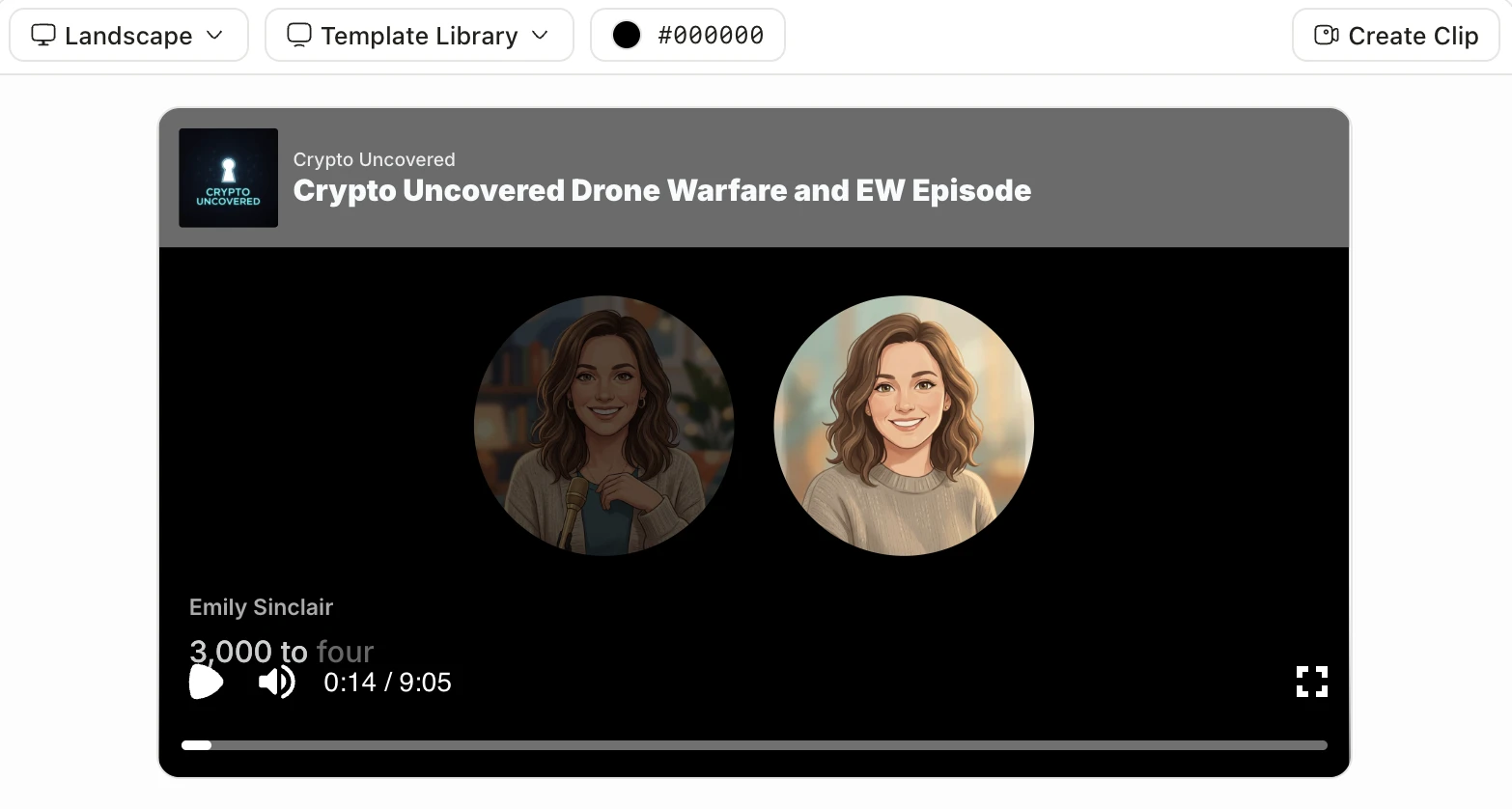
An internal communications podcast is a private audio show your organization distributes only to employees: company updates, leadership messages, policy changes, and all-hands recaps delivered as conversational audio instead of email. If you are building a public show for an external audience of customers or prospects, the branded podcast guide covers that workflow instead. If most of your audience is on a floor, a truck, or a shift rather than at a desk, see frontline employee communication for how the format changes for that audience specifically.
The format is not new. Large companies have experimented with internal audio channels for years. What changed is that producing one no longer requires a studio, a production team, or an audio engineer. It now takes the same materials your comms team is already writing, run through a tool that converts them into audio. The pattern is already common: across Jellypod, uploaded documents are the most frequent source for an episode, used about three times as often as pasted text or a link, which fits a comms team that already produces written updates.
Why internal comms gets ignored
The problem with most internal communications is not the content. It is the format.
Email asks employees to stop what they are doing and read. Most do not, at least not in full. Internal newsletters and company-wide announcements tend to follow the same pattern: a team works to write and format the update, it goes out Friday afternoon, and a significant portion of the workforce never reads past the subject line. For distributed teams across time zones, the gap between "sent" and "seen" can stretch into days.
Audio travels differently. People listen during commutes, between meetings, on a walk, or at lunch. They finish audio at much higher rates than written content, not because the topic is more engaging, but because listening does not compete with the inbox for attention. It slots into windows when reading is not possible.
An internal podcast does not replace email. It gives the same information a second route to the same audience, one that reaches people when they have time to pay attention.
What to put in an internal communications podcast
Not every type of internal content translates to audio. These are the formats that work:
All-hands recap. A 10-15 minute conversational episode summarizing the quarterly all-hands covers the key decisions, priorities, and context for employees who missed the live session or tuned out during a long Zoom. It is faster to listen to than rewatching a recording.
Leadership message. A weekly or biweekly update from the CEO, a department head, or a regional lead covering what the company is focused on, what changed, and why. More personal than an email blast, harder to skip.
Policy and process changes. New HR policies, benefits updates, compliance reminders, and process changes explained conversationally rather than distributed as a PDF attachment. Explaining the reasoning behind a change reduces friction and follow-up questions. See compliance training best practices for how this extends into a full regulatory training program.
Product and market updates. For go-to-market and sales teams, a short weekly episode covering what shipped, what is selling, and what the competitive landscape looks like. The same content that goes into a battlecard, delivered as audio reps can listen to on their commute. See the sales enablement podcasts guide for how this workflow fits into a rep training program.
Onboarding series. A short series for new hires covering company history, culture, team structure, and role context, distributed automatically when someone joins. A structured audio track reduces how much onboarding falls through the cracks when managers are busy. See onboarding training new hires actually finish for how to build the full track.
How to start an internal communications podcast
Three things make internal podcasts harder than public ones: production effort, private distribution, and access control. Jellypod handles all three.
Step 1: Create a private podcast. Jellypod supports publishing to a private RSS feed. The feed is not indexed by any public podcast directory, which means it is not discoverable in Spotify's search or Apple Podcasts' catalog. Only employees with the feed URL can subscribe. Spotify and Apple Podcasts still require a compliant cover image before they will display a private feed in their apps; see the podcast cover art guide for the required dimensions and file format.
Step 2: Generate episodes from existing content. You already have the source material. Upload the all-hands transcript, the policy document, the leadership brief, the weekly update email, or your raw meeting notes to Jellypod. It generates a conversational two-host episode from that source, scripted and ready for you to review before the audio renders. The workflow for a 10-minute episode typically takes under 30 minutes from source document to published audio. No one needs to record anything. See how to turn your notes into a podcast if a meeting recap or a bullet-point agenda is the only source material you have.
Step 3: Distribute the feed URL to employees. Share the private RSS link via Slack, email, or your intranet. Employees subscribe in Spotify, Apple Podcasts, Overcast, or any podcast app they already use. The episode appears in their personal library alongside everything else they listen to. No separate app, no VPN requirement, no IT ticket.
For organizations managing multiple communication channels or departments, the Jellypod Teams feature lets you run separate podcast feeds under one account with centralized billing and role-based access controls. An HR team can own their benefits update feed while a product team manages a separate customer update feed, both under the same organizational account.
Why most internal podcasts fail
The internal podcasts that get abandoned share a common pattern: production becomes the bottleneck.
When creating one episode requires a recording session, a round of editing, a review cycle, and a separate publishing workflow, the show slows down. The first episode takes three weeks. The second takes a month. By the fourth episode, no one has time, and the feed goes quiet.
Jellypod removes most of that friction by design. You are not recording hosts in a studio. You are converting documents your comms team already writes into audio. The review step is editing a script in a text interface, not sitting in a booth. That changes the sustainable publishing cadence from "quarterly when bandwidth allows" to "whenever there is something worth saying."
The organizations that run consistent internal podcasts treat episodes the way they treat newsletters: a standing workflow that outputs an episode when there is source material, not a production project they spin up from scratch each time. That workflow is what an AI agent for marketing actually looks like in practice: research, script, and audio production running on a schedule, with a person reviewing rather than producing.
For teams building a broader internal content system, the B2B content repurposing playbook covers how to turn a single source (a recorded call, a report, a leadership message) into multiple formats without duplicating effort.
FAQ
What is an internal communications podcast?
An internal communications podcast is a private audio show distributed only to employees via a restricted RSS feed. It covers company updates, leadership messages, policy changes, and other internal content in a conversational audio format, delivered to standard podcast apps like Spotify and Apple Podcasts.
How do you keep an internal podcast private?
The simplest method is a private RSS feed with an unlisted URL that is not submitted to any public podcast directory. Jellypod supports private RSS publishing, so the feed does not appear in podcast app searches or directories. Employees access it by subscribing to the URL directly, and anyone outside your organization cannot discover or access the show.
How long should internal podcast episodes be?
Most internal podcast episodes run between 8 and 15 minutes. That is long enough to cover a topic with enough context to be useful, and short enough to finish during a commute or a lunch break. Weekly leadership updates tend to run 5-8 minutes. Quarterly all-hands recaps and onboarding episodes can run 15-25 minutes.
How often should you publish?
Weekly works for most internal comms teams. It is frequent enough to build a listening habit and stay relevant, and infrequent enough that most organizations can sustain it. Biweekly works for smaller organizations or teams with less source material week-to-week.
Do you need to record your own voice?
No. Jellypod generates conversational episodes from documents and source materials using AI hosts. For leadership updates where tone matters, voice cloning lets you create a host voice that matches a specific person's voice, so a CEO update sounds like the CEO without requiring them to record anything. No studio sessions required.
What is the difference between an internal podcast and an external podcast?
The audience and distribution model. An external podcast is published publicly and indexed by podcast directories. An internal podcast is distributed only to employees via a private RSS feed that is not publicly searchable. The production process is the same; only the distribution differs.