Most patients leave a visit with a handout they never reread. Clinics can make patient education materials work beyond the page by keeping the approved handout as the source of truth and turning it into audio or short video patients can replay at home.
That is the workflow Jellypod supports. You upload the handout, discharge summary, or care plan you already use, Jellypod drafts a script from that document, and you edit and approve every line before any audio is generated. The same source can then be produced in any of 121 languages.
Key takeaways
- Written instructions are recalled correctly about 58% of the time in emergency department patients, against 47% for verbal-only and 67% for video, though the 2019 meta-analysis found those gaps were not statistically significant on their own.
- Only 12% of US adults scored proficient on the 2003 national health literacy assessment, so a handout written for the average reader misses many of the people holding it.
- Audio and video are add-ons to the approved handout, not replacements. Keep the print copy for phone numbers and dosage schedules.
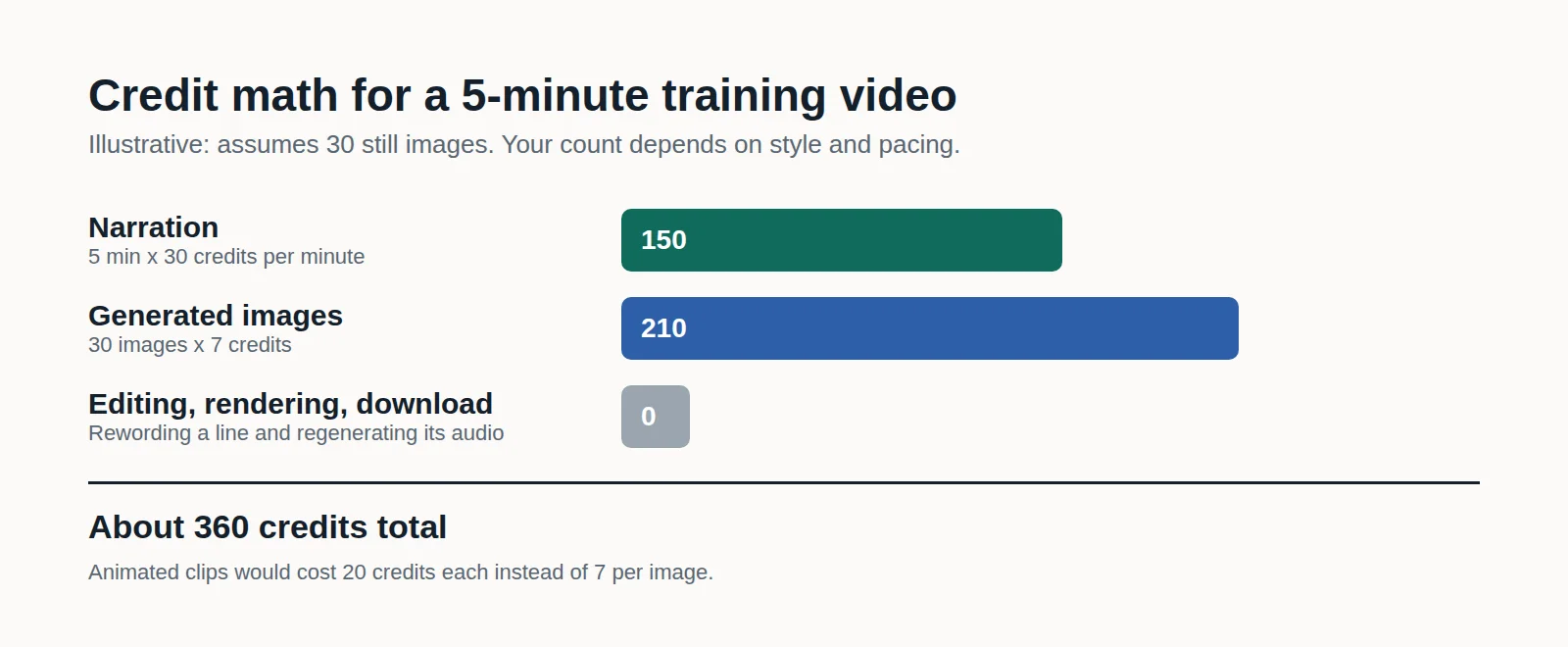
- Jellypod drafts from your uploaded document, lets you edit the script line by line, and charges 30 credits per minute of audio. Drafting and editing are free.
- Jellypod no longer offers new Unlisted podcasts, and Private podcasts have no RSS feed. Check how you will deliver patient-specific audio before you promise it.
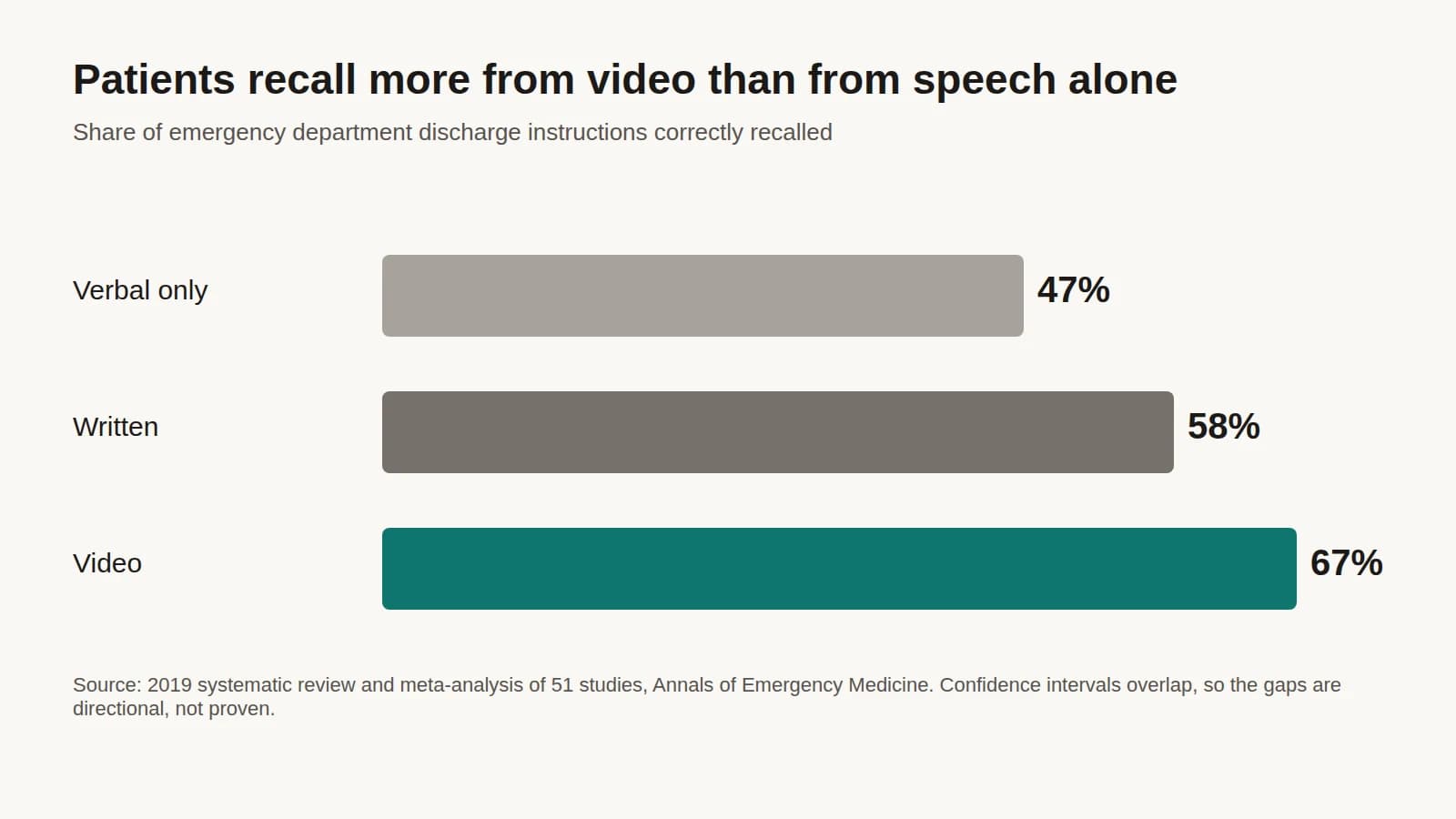 Recall figures from the 2019 Annals of Emergency Medicine meta-analysis cited below.
Why don't patients remember their discharge instructions?
Format and reading level both work against them. A 2019 systematic review and meta-analysis in Annals of Emergency Medicine pooled 51 studies of emergency department discharge instructions. Patients correctly recalled an average of 47% of verbal instructions, 58% of written ones, and 67% of video ones. The confidence intervals overlap, so treat this as a direction, not proof that video wins.
Reading level is the second problem. The 2003 National Assessment of Adult Literacy found 12% of US adults proficient in health literacy, 53% intermediate, 21% basic, and 14% below basic. Stress and pain lower anyone's reading ability in the moment, so a handout that looks clear in the office can fail at the discharge desk.
Low literacy also shows up in outcomes. A 2015 BMJ Open study of 7,733 Medicare beneficiaries hospitalized for heart attack found above-basic health literacy went with a 12% lower adjusted risk of 30-day readmission (risk ratio 0.882, 95% CI 0.788 to 0.987). It is an association, not a test of handout format.
Does audio or video help patients understand more than a handout?
The evidence for video is stronger than the evidence for audio alone.
For video, a 2024 JMIR systematic review by Hansen and colleagues covered 15 randomized trials with 2,454 patients. Eleven reported statistically significant gains in recall from animation videos compared with usual care, and all three that used whiteboard animation did. In an emergency department trial of 240 patients, video discharge instructions raised comprehension from 30.1% to 52.3%.
Video did not help everywhere. In that same trial, splint care (53% to 66%) and suture care (29% to 31%) showed no significant difference, which suggests hands-on tasks need a demonstration on the patient's own body, not just an explanation.
For spoken narration, a 2015 JMIR study tested health animations with 231 adults aged 55 and older. In the low health literacy group, spoken text scored 11.42 for recall against 9.12 for written text, and with spoken text that group recalled about as much as the high literacy group. That study used animations, not audio-only, so it supports narration, not podcasts specifically.
None of this is a reason to drop the handout. It is a reason to stop making it the only thing a patient gets.
How do you turn an approved handout into audio?
Start from the document your clinicians already signed off on. Jellypod's PDF to podcast tool accepts PDFs, Word files (.doc, .docx), RTF, and other document types, up to 100 MB per file. PDFs over 250 pages are trimmed to the first 250 automatically, per the supported source types doc.
- Upload the handout or care planJellypod drafts the script from what the document says, not from a generic explanation of the condition.
- Edit the script against the sourceCheck drug names, doses, dates, and phone numbers line by line. The script editor is where a clinician approves the wording, and nothing is generated as audio until you choose to.
- Pick a voiceUse a library voice, or clone a clinician's own voice so patients hear a familiar speaker without a recording session.
- Generate and deliverNarration costs 30 credits per minute, so a 3-minute explainer is 90 credits. The Starter plan includes 5,000 credits a month, enough for about 166 minutes of narration. Drafting, editing, and downloading are free.
Jellypod does not replace clinical review. A clinician still owns the content, the same as for a printed sheet.
How do you deliver audio to one patient without making it public?
This is the limit to plan around before you promise anything. Every Public Jellypod podcast gets an RSS feed, and anyone with the feed URL can subscribe. A Private podcast has no RSS feed, no website, and no share links, so its episodes are downloaded from the Studio.
Unlisted podcasts, which kept a feed off public directories, are retired for new podcasts. Existing Unlisted podcasts keep working. Details are in the RSS feed doc and editing podcast details.
In practice, that gives clinics two workable patterns:
- Public feed for general education (diabetes basics, pre-op prep) that contains nothing patient-specific.
- Private podcast, downloaded MP3, delivered through your own secure channel such as a patient portal, for anything tied to a named patient's care plan.
Confirm with your compliance team, and with Jellypod, whether your agreement covers protected health information before you upload any. Where possible, upload the generic handout, not a document with patient identifiers.
Can you make patient education materials in a patient's own language?
Yes. Jellypod generates episodes in 121 languages, and each library voice is tuned to one language and accent. A voice clone can speak new languages while keeping its identity.
One handout can become Spanish, Mandarin, and Arabic audio without a separate production run, at the same credit cost per minute. Translation quality still matters for medical content: have a bilingual clinician or qualified interpreter listen before release, the same as you would with any translated handout.
Does audio replace the printed handout or the teach-back check?
No on both counts. A printed sheet is still the right place for a phone number or dosage table a patient needs to glance at. Audio and video explain the reasoning behind an instruction, and they can be replayed before a follow-up call.
Teach-back, where the patient explains the plan back in their own words and the clinician corrects any gap, remains the live check that understanding happened. Audio and video give the patient something to review afterward so less has to be relearned at the next visit.
What does this look like in practice?
Dr. Muhamad Aly Rifai, a practicing psychiatrist and former National Institute of Mental Health researcher, built a patient-facing channel on Jellypod because traditional production was too slow and expensive for a working clinician. His workflow is to outline a topic with four or five references, generate and expand it in Jellypod, add clinical nuance, and publish. His ADHD episode went viral on Spotify, and his YouTube channel grew from roughly 150 subscribers to over 1,000. In his words, "people were hungry for information from a real psychiatrist."
That is public education, not patient-specific care plans, so it shows reach more than clinical workflow.
For video, Jellypod's AI video generator produces captioned videos from the same source, and the explainer video basics post covers how to choose a format. If your team also trains staff on the new materials, the employee training videos guide covers that side, and the universal design for learning examples show how multiple formats serve mixed-ability audiences.
Frequently asked questions
What is a patient education handout?
A printed sheet or PDF a clinic gives a patient to explain a diagnosis, procedure, medication, or after-visit care. It is the most common format for patient education, and the research above suggests it is rarely enough by itself.
Is video better than a written handout for patient education?
For informational content, the trial evidence leans toward video. A 2024 review of 15 randomized trials found 11 reported significant recall gains, and an emergency department trial found comprehension rose from 30.1% to 52.3%. For hands-on tasks like splint or suture care, video showed no significant gain.
Can Jellypod make a private audio file for one patient?
Yes, as a downloaded file. A Private podcast has no RSS feed, so you download the MP3 and deliver it yourself, for example through a patient portal. Public podcasts have a feed anyone with the link can subscribe to.
How much does a patient education episode cost?
Narration is 30 credits per minute. A 3-minute episode uses 90 credits, and the Starter plan includes 5,000 credits each month.
The short version
Keep the handout your clinicians approved, and add audio or video as a second way in. Upload the document to Jellypod, edit the script against the source, choose a language, and decide up front how each patient will receive the file.