An explainer video costs anywhere from about a dollar to five figures, and the gap tracks one thing: how much of the video a person makes by hand. Agencies and freelancers quote per project, so you rarely see the number until you ask.
Jellypod publishes its price list, so we can do the math in public. A 60-second whiteboard explainer generates for about 65 credits ($0.65), and a 90-second one for about 105 credits ($1.05). Those figures cover generation only, not your time writing the script or your subscription. The ranges for human production below are our own planning estimates, not survey data.
Key takeaways
- Human production is priced per project: roughly $0 to $500 for a DIY template tool, $500 to $5,000 for a freelancer, and $5,000 to $25,000 for a studio (our planning ranges, so get three quotes).
- Jellypod charges 30 credits per minute of narration, 7 credits per generated image, and 20 credits per animated clip, at $10 per 1,000 credits.
- At default pacing, a 60-second whiteboard explainer costs about 65 credits and a 90-second one about 105. An animated-clip style costs about 130 and 205.
- Regenerating narration is free, and rendering, publishing, and downloading never use credits.
- A studio still makes sense for a custom-illustrated brand film. A product or training explainer that changes often does not need one.
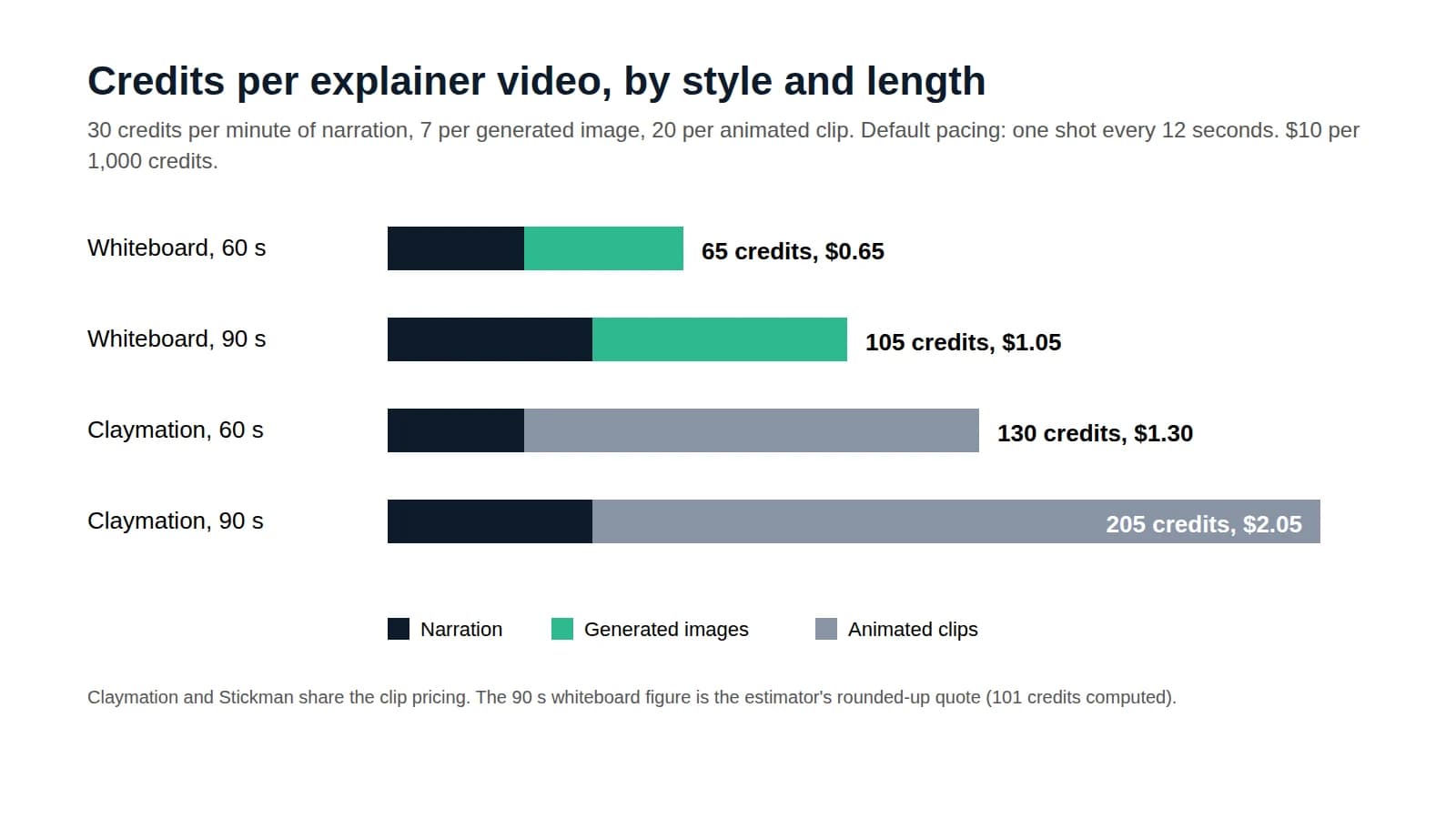 Credits split into narration and visuals, using the calculation below.
How much does an explainer video cost by production method?
Price follows custom labor, not runtime. A 30-second and a 90-second explainer in the same style cost close to the same from a human team, because the fixed cost is scripting, illustration, and setup.
The first three rows are ranges we use for planning, not published survey figures, and quotes vary widely by scope. Ask for itemized quotes that separate scripting, illustration, voiceover, and revisions.
Other AI video tools price differently, some per seat and some per minute. Our comparison of Synthesia, Pictory, and InVideo alternatives covers how they differ.
How much does a 60 to 90 second Jellypod explainer cost?
Credits are charged when Jellypod generates narration or visuals, by one formula for every video. Here is the calculation, using the pacing the estimator assumes.
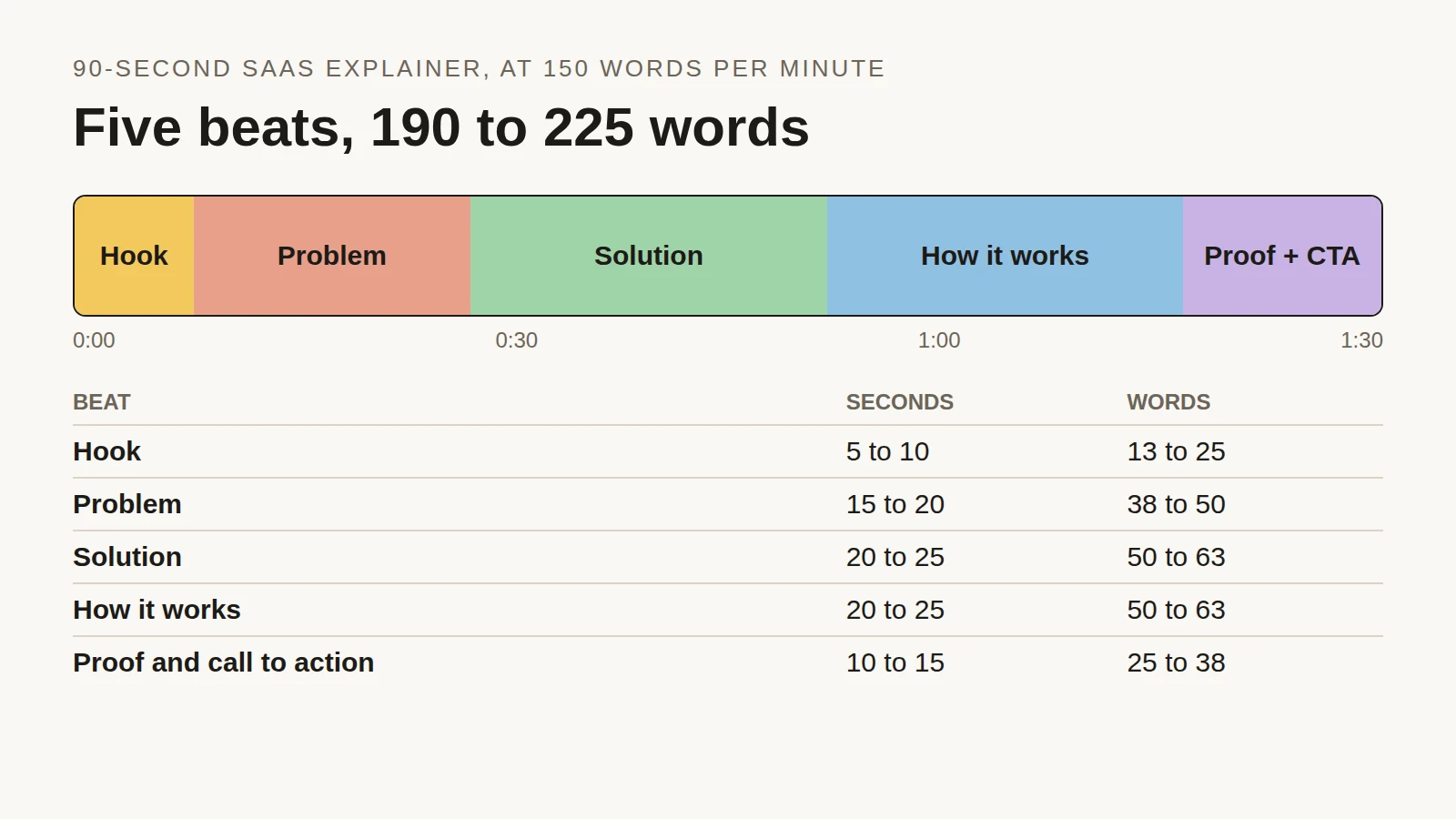
- Write the script. Jellypod's estimator assumes 130 spoken words per minute, so 60 seconds is about 130 words and 90 seconds is about 195. Our explainer video script guide covers structure and length.
- Narration costs 30 credits per minute: 30 credits for 60 seconds, 45 for 90.
- Videos get a new shot every 4 to 20 seconds, so the estimate uses a 12-second average: 5 shots for 60 seconds, 8 for 90.
- Each shot is a generated image (7 credits) or, in animated styles, a generated clip (20 credits).
Jellypod shows an estimate before generation, rounded up to the next 5 credits, and holds those credits while it works. When generation finishes, the charge settles to what was generated, and a failed generation is released without a charge. The full rules are in Understanding Credits.
Credits come with a subscription. Starter includes 5,000 credits a month, enough for about 75 of the 60-second whiteboard videos above. Actual shot counts depend on your script, so treat the table as a forecast and check the estimate for your own.
Does the video style change the price?
Between styles, yes, but only by the visual type. Whiteboard Explainer generates an image for each shot and reveals it with a marker-drawing effect, so each shot costs 7 credits. Styles like Claymation and Stickman generate an animated clip per shot at 20 credits, up to 10 clips in one video.



With a human team the reverse holds: animation styles that need more custom art per second cost more, and every extra revision round adds to the invoice. The whiteboard explainer page shows finished examples of the cheapest Jellypod style.
What does an agency give you that AI video does not?
A team that designs original characters, holds a brand voice across many projects, and gives you one person to manage the work. That is why flagship campaign films and brand videos still go to studios.
The narrower job is where generation fits: a product walkthrough, a feature launch, or an employee training video that has to change when the product does. Editing the script and regenerating narration use no credits, and regenerating a single visual costs 7 credits, so a pricing change does not reopen a project. If you are unsure which format to make, what an explainer video is lays out the common types.
Script edits, publishing, and exports use no credits. Jellypod has a Free plan with 500 credits and no credit card, and paid plans include a 7-day free trial.
Paste your script into the AI explainer video generator and read the credit estimate before you generate anything.